
When someone is diagnosed with dementia, most families expect memory loss. What many don’t realize is how dementia changes the brain over time and how those changes can affect nearly every aspect of daily life. As the disease progresses, it may become difficult for a person to walk, eat, swallow, speak, recognize loved ones, or complete everyday tasks that once felt effortless.
These changes can be heartbreaking to witness. A parent who once walked independently may suddenly struggle to stand or lose their balance. Someone who always enjoyed meals may begin refusing food, holding it in their mouth, or forgetting how to swallow. Conversations become shorter, words become harder to find, and eventually communication may become limited or disappear altogether.
These changes are not caused by stubbornness, laziness, or a lack of effort. They happen because dementia gradually damages different parts of the brain responsible for memory, movement, language, coordination, judgment, and other essential functions. As brain cells are damaged and the connections between them are lost, the brain can no longer process information and control the body as it once did.
Understanding how dementia changes the brain can help families better understand what their loved one is experiencing, anticipate future changes, make informed care decisions, and respond with greater patience, empathy, and compassion.
If you’re new to dementia, the Alzheimer’s Association offers reliable information about Alzheimer’s disease and other types of dementia, along with practical caregiving resources and support for families.
Quick Answer
Dementia gradually damages different regions of the brain that control memory, movement, language, swallowing, judgment, behavior, and other essential functions. As the disease progresses, a person may slowly lose the ability to walk safely, eat and swallow normally, communicate effectively, recognize familiar people, or perform everyday activities independently. These changes are a result of the disease affecting the brain—not a person’s choice or lack of effort.
Understanding What Dementia Does to the Brain
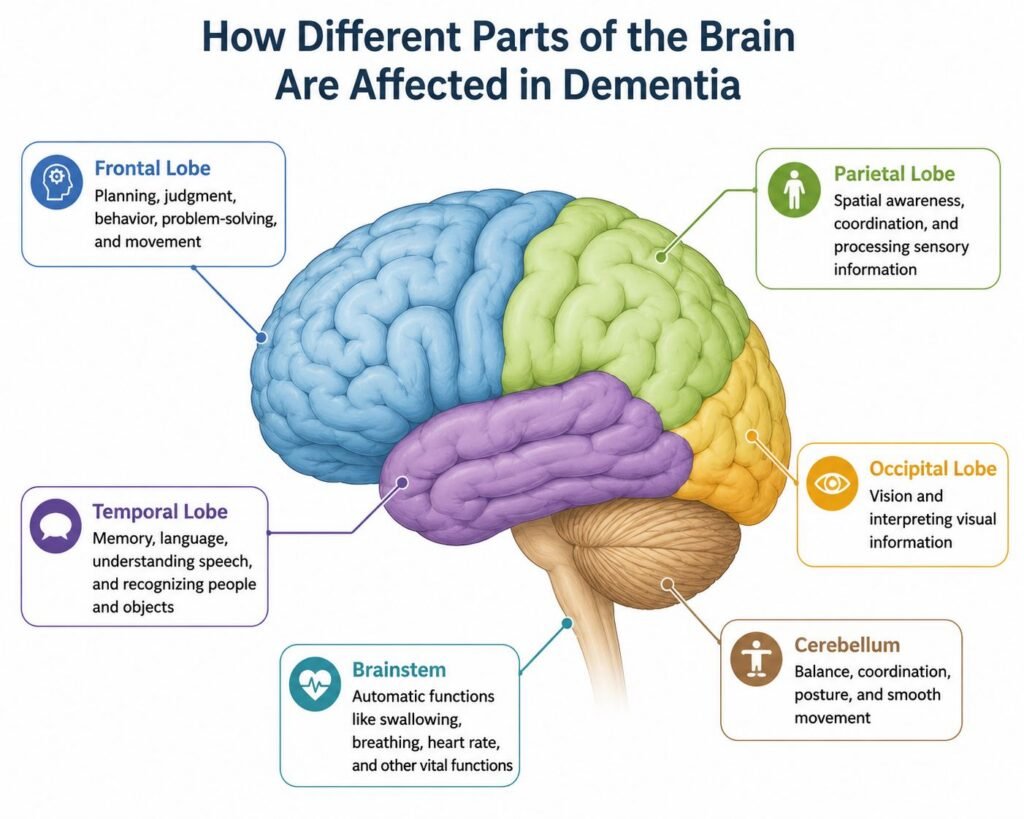
To understand why dementia affects so many different abilities, it helps to know that the brain is made up of specialized regions that work together like an interconnected network. Each region is responsible for certain functions, such as memory, movement, language, balance, vision, and decision-making.
As dementia progresses, it damages brain cells and the connections between them. Messages can no longer travel efficiently from one part of the brain to another, making it increasingly difficult for the brain to process information and coordinate even familiar tasks.
The symptoms a person experiences often depend on which areas of the brain are most affected.
| Brain Area | Primary Functions |
| Frontal lobe | Planning, decision-making, judgment, behavior, problem-solving, and voluntary movement |
| Temporal lobe | Memory, language, understanding speech, and recognizing familiar people and objects |
| Parietal lobe | Spatial awareness, coordination, and processing sensory information |
| Occipital lobe | Vision and interpreting visual information |
| Cerebellum | Balance, coordination, posture, and smooth movement |
| Brainstem | Helps regulate automatic functions such as breathing, heart rate, and aspects of swallowing |
Although different types of dementia affect the brain in different ways, damage to these interconnected regions is what leads to the gradual loss of memory, movement, communication, and other everyday abilities.
Because these regions work together, damage in one area can affect many different abilities. This is why dementia is much more than a memory disorder. As the disease advances, it can gradually interfere with walking, eating, speaking, swallowing, reasoning, recognizing loved ones, and performing everyday activities independently.
Memory Changes Are Usually the First Sign
For many people, memory loss is the earliest noticeable symptom of dementia. This is because Alzheimer’s disease, the most common type of dementia, and several other forms of dementia often begin by damaging areas of the brain responsible for forming and storing new memories, particularly the hippocampus.
Early on, a person may have difficulty remembering recent events, even though memories from many years ago remain relatively intact.
Common early memory changes include:
- Forgetting recent conversations or appointments
- Repeating the same questions or stories
- Misplacing everyday items
- Becoming confused about the date, time, or place
- Getting lost in familiar neighborhoods or buildings
As dementia progresses and more areas of the brain become affected, long-term memories may also begin to fade. A person may eventually have difficulty recognizing familiar faces, recalling important life events, or remembering close family members.
Walking and Mobility Become More Difficult
Many families are surprised when a loved one with dementia gradually loses the ability to walk. While this may seem like a problem with the legs or muscles, walking is actually a complex brain function that depends on many different systems working together.
Every step requires the brain to coordinate:
- Balance
- Muscle movement
- Vision
- Judgment
- Spatial awareness
- Timing
- Coordination
As dementia damages the brain, these systems can no longer communicate as effectively. Tasks that once happened automatically such as standing up, taking a step, turning around, or avoiding obstacles, may become increasingly difficult.
As a result, a person may begin to:
- Shuffle their feet
- Walk more slowly
- Freeze or hesitate while walking
- Lose their balance more often
- Have difficulty judging distances or navigating familiar spaces
- Forget how to safely use a walker or cane
- Need increasing assistance with walking
- Eventually lose the ability to walk altogether
For many people with advanced dementia, this loss of mobility is primarily caused by changes in the brain rather than muscle weakness alone.

As the disease progresses, the brain gradually loses its ability to coordinate the complex processes required for safe and independent movement.
Understanding this can help families recognize that their loved one is not choosing to stop walking. Instead, the disease is progressively affecting the brain’s ability to control movement, making walking increasingly difficult despite the person’s best efforts.
If you’d like to learn more about the specific brain changes behind mobility loss, common walking problems, and what families can expect as dementia progresses, read our guide, Why People with Dementia Stop Walking: Understanding the Brain Changes Behind Mobility Loss.
Eating and Swallowing Become More Challenging
One of the most heartbreaking changes families may experience is watching a loved one with dementia gradually lose the ability to eat. While it can appear that the person is refusing food, these changes are often caused by the disease affecting the brain rather than a loss of desire or willpower.
Eating is a surprisingly complex process. The brain must recognize food, remember how to use utensils, coordinate chewing, and trigger the automatic reflex that allows a person to swallow safely. As dementia damages these areas of the brain, these everyday tasks can become increasingly difficult.
A person may begin to:
- Forget how to use utensils
- Lose interest in food or forget to eat
- Hold food in their mouth (called food pocketing)
- Forget to chew thoroughly
- Have difficulty swallowing food or liquids
- Cough or choke more often during meals
- Require softer foods or modified food textures
- Eventually become unable to eat safely without assistance
These changes are neurological, not behavioral. In most cases, the person is not choosing to stop eating. Instead, their brain is gradually losing the ability to perform a process that most of us take for granted.
As swallowing becomes more difficult, the risk of choking, dehydration, weight loss, and aspiration (food or liquid entering the lungs) also increases. This is why changes in eating or swallowing should always be discussed with a healthcare provider.
To better understand why these changes occur, what food pocketing and swallowing difficulties mean, and how families can safely support a loved one during mealtimes, read our guide, Why People with Dementia Stop Eating: Understanding the Brain Changes Behind Eating and Swallowing Difficulties.
Communication Gradually Changes
As dementia progresses, it can damage the areas of the brain responsible for language, making it increasingly difficult for a person to express their thoughts or understand what others are saying. Communication often becomes one of the most challenging aspects of the disease for both the person living with dementia and their loved ones.
A person may begin to:
- Struggle to find the right words
- Repeat the same questions or stories
- Lose track of conversations
- Use incorrect or substitute words
- Have difficulty understanding longer or more complex sentences
- Speak less frequently or respond with only a few words
- Eventually rely more on facial expressions, gestures, touch, or other nonverbal forms of communication
These changes can be frustrating for everyone involved, but they are a result of the disease affecting the brain—not a lack of interest in communicating.
Even when someone can no longer speak clearly, they may still recognize a familiar voice, respond to a gentle touch, or find comfort in a calm, reassuring presence. Speaking slowly, using simple sentences, maintaining eye contact, and allowing extra time for a response can help reduce frustration and make communication more meaningful.
Everyday Tasks Become More Difficult
Many of the activities we perform every day, such as getting dressed, brushing our teeth, or making a meal, feel automatic because our brains have practiced them for years. In reality, these tasks require the brain to plan, remember each step, make decisions, and carry out actions in the correct order.
As dementia progresses, these abilities gradually decline, making every day routines increasingly difficult.
A person may have trouble:
- Brushing their teeth or completing other personal hygiene tasks
- Getting dressed appropriately or in the correct order
- Preparing meals or making a cup of coffee
- Remembering to take medications
- Using household appliances safely
- Managing finances or paying bills
- Using the bathroom independently
These changes occur because dementia affects the brain’s ability to plan, organize, sequence, and solve problems. A person may know what they want to do but no longer be able to figure out the steps required to do it.
As a result, tasks that once took only a few minutes may require reminders, supervision, or hands-on assistance. Understanding that these challenges are caused by changes in the brain, and not by laziness or a lack of effort, can help caregivers respond with greater patience and compassion.
Personality and Behavior May Change
Dementia doesn’t just affect memory, it can also change a person’s personality, emotions, and behavior. These changes can be especially difficult for families because they may feel as though their loved one has become a different person.

As dementia damages areas of the brain responsible for judgment, emotional regulation, and impulse control, a person may begin to:
- Become more withdrawn or less interested in social activities
- Feel suspicious or believe things that are not true
- Experience increased anxiety or fear
- Become agitated or irritable more easily
- Feel restless or pace frequently
- Have less awareness of social situations or appropriate behavior
- React more strongly to changes in routine or unfamiliar environments
These changes are symptoms of the disease, and not intentional changes in personality or behavior. The person is not choosing to act differently. Instead, dementia is affecting the parts of the brain that help regulate emotions, interpret situations, and respond appropriately.
Understanding this can help caregivers respond with patience and empathy. Rather than arguing, correcting, or taking hurtful comments personally, it is often more helpful to provide reassurance, maintain a calm environment, and look for possible triggers such as pain, hunger, fatigue, or overstimulation.
Eventually, the Brain Can No Longer Coordinate Basic Body Functions
In the later stages of dementia, the disease affects more areas of the brain, including those responsible for coordinating many of the automatic functions most of us rarely think about. As a result, a person may gradually lose abilities that were once effortless.
A person may eventually lose the ability to:
- Walk independently
- Speak or communicate with words
- Eat without assistance
- Swallow safely
- Sit upright without support
- Control bladder and bowel function
As these abilities decline, the body becomes more vulnerable to complications such as dehydration, malnutrition, weight loss, infections, aspiration pneumonia, and pressure injuries. These complications often occur because the brain can no longer effectively coordinate essential body functions.
Although these changes can be difficult to witness, they are a natural part of the progression of advanced dementia. They do not mean that a person has stopped trying or chosen to give up. Instead, they reflect the gradual loss of the brain’s ability to control the body.
Understanding what is happening can help families prepare for their loved one’s changing care needs, recognize when additional support is needed, and have informed conversations with their healthcare team about comfort-focused care, including palliative care and hospice.
If your loved one lives in a nursing home, our guide, Hospice Care in a Nursing Home: Who Provides What and What Medicare Covers, explains how hospice works alongside nursing home care, who provides which services, and what Medicare does and does not cover. As dementia progresses, many families also begin exploring whether a memory care community may provide the specialized environment and support their loved one needs.
Why Understanding How Dementia Changes the Brain Matters
Recognizing that these changes are caused by damage to the brain, and not by stubbornness, laziness, or a lack of effort, can completely change the way families understand and respond to dementia.
Instead of asking:
“Why won’t Mom eat?”
Families may begin asking:
“What is her brain no longer able to do?”
That simple shift in perspective can make an enormous difference. It replaces frustration with understanding, blame with empathy, and conflict with compassion.
Understanding how dementia changes the brain also helps families:
- Set realistic expectations as the disease progresses
- Recognize that many difficult behaviors are symptoms of dementia, not intentional actions
- Adapt care strategies to their loved one’s changing abilities
- Communicate more effectively and patiently
- Know when it may be time to seek additional support
Caring for someone with dementia can become increasingly demanding as the disease progresses. As responsibilities grow and your loved one’s needs change, many family caregivers experience stress, exhaustion, and emotional burnout.

Recognizing the signs early and seeking support can help you continue providing compassionate care while also protecting your own well-being. Learn more in our guide, Family Caregiver Burnout: Warning Signs, Causes, and Support Every Caregiver Needs.
Over time, some families may also begin considering whether a memory care community is the right next step. Learning what specialized memory care provides, when it may be appropriate, and how it differs from other senior care options can help families make informed decisions with greater confidence.
When Should Families Talk to the Doctor?
While dementia causes gradual changes over time, a sudden decline should never be assumed to be part of the disease. New or rapidly worsening symptoms may be caused by a treatable medical condition and should be evaluated by a healthcare provider as soon as possible.

Contact your loved one’s healthcare provider if they suddenly:
- Stop walking or have a significant decline in mobility
- Experience repeated falls
- Refuse food or liquids for an extended period
- Frequently cough or choke while eating or drinking
- Lose weight rapidly or show signs of dehydration
- Become much more confused, sleepy, or difficult to wake than usual
- Develop sudden changes in speech, alertness, or behavior
In many cases, these changes may be caused by conditions such as a urinary tract infection (UTI), pneumonia, dehydration, medication side effects, constipation, pain, or even a stroke rather than the progression of dementia itself. Identifying and treating these underlying conditions can sometimes improve symptoms or prevent further complications.
If your loved one develops sudden weakness on one side of the body, difficulty speaking, severe shortness of breath, chest pain, or becomes unresponsive, seek emergency medical care immediately.
Key Takeaways
- Dementia is a progressive brain disease that affects much more than memory.
- Different areas of the brain control memory, movement, language, swallowing, behavior, and the ability to perform everyday tasks.
- As dementia damages these areas, a person may gradually lose the ability to walk, eat, communicate, and live independently.
- These changes are symptoms of the disease—not stubbornness, laziness, or a lack of effort.
- Understanding how dementia changes the brain can help families respond with greater patience, empathy, and compassion.
- Knowing what to expect as dementia progresses can help families plan ahead, make informed care decisions, and seek the right support when it is needed.
Final Thoughts
Watching a loved one gradually lose abilities they once performed without thinking is one of the most heartbreaking aspects of dementia. While these changes may sometimes seem sudden, they are usually the result of progressive damage to different parts of the brain over months or years.
Although there is currently no cure for most forms of dementia, understanding what is happening inside the brain can replace confusion with knowledge, frustration with empathy, and fear with greater confidence. Knowing why these changes occur helps families respond with patience, adapt to their loved one’s changing needs, and make informed decisions about care. Families who would like to continue learning about dementia, caregiving, and the latest evidence-based information can also explore the National Institute on Aging’s Alzheimer’s and Dementia Resources.
As the disease progresses, additional support may become necessary, whether that involves home health care, transitioning to a specialized memory care community, palliative care, or hospice. If you’re wondering when that step may be appropriate, our guide to Memory Care Explained: A Complete Guide for Families Navigating Alzheimer’s and Dementia Care can help you understand what memory care offers and when families typically begin considering it.
Most importantly, remember that while dementia changes many abilities, it does not erase a person’s need for love, dignity, comfort, and human connection. Even when words fade and everyday tasks become impossible, kindness, reassurance, and simply being present continue to matter.
The more you understand how dementia changes the brain, the better prepared you’ll be to make informed decisions, adapt to each stage of the disease, and provide compassionate care throughout your loved one’s journey.
Frequently Asked Questions
Every person’s experience with dementia is unique, and families often have questions as new symptoms appear over time. The answers below address some of the most common questions about how dementia affects the brain and why it can change memory, movement, communication, eating, and other everyday abilities.
Does dementia only affect memory?
No. While memory loss is often one of the earliest symptoms, dementia affects much more than memory. As the disease progresses, it can also impair movement, language, swallowing, judgment, behavior, vision, balance, and the ability to perform everyday activities independently.
Why do people with dementia stop walking?
Walking requires many areas of the brain to work together to control balance, coordination, muscle movement, vision, and spatial awareness. As dementia damages these brain networks, walking may become slower, less stable, and eventually impossible without assistance.
Why do people with dementia stop eating?
In the later stages of dementia, the brain may lose the ability to recognize food, coordinate chewing and swallowing, or remember the steps involved in eating. These changes are caused by the disease affecting the brain and not by a lack of appetite or a person’s choice to stop eating.
Can someone with dementia still understand us if they can’t speak?
Often, yes. Even when speech becomes limited or disappears, many people with dementia can still recognize familiar voices, respond to facial expressions, feel comfort from gentle touch, and sense the emotional tone of those around them. Speaking calmly, using simple sentences, and offering reassurance can continue to provide comfort and connection.
Does everyone with dementia lose the ability to walk or eat?
No. Dementia affects each person differently. The symptoms, rate of progression, and loss of abilities vary depending on the type of dementia, the areas of the brain affected, the person’s overall health, and other individual factors. While many people with advanced dementia eventually experience significant physical decline, not everyone follows the same path or timeline.
Can dementia affect swallowing?
Yes. As dementia progresses, it can interfere with the brain’s ability to coordinate swallowing, a condition known as dysphagia. This can increase the risk of choking, aspiration (food or liquid entering the lungs), dehydration, and weight loss. Any new difficulty swallowing should be discussed with a healthcare provider.
Why do people with dementia change their personality?
Dementia can damage areas of the brain responsible for emotional regulation, judgment, and behavior. As a result, someone who was once outgoing may become withdrawn, anxious, suspicious, or easily frustrated. These changes are symptoms of the disease rather than intentional changes in personality.
When should someone with dementia see a doctor?
Families should contact a healthcare provider if a person with dementia experiences a sudden decline, such as increased confusion, repeated falls, difficulty swallowing, refusal to eat or drink, rapid weight loss, or significant changes in speech or alertness. Sudden changes may be caused by treatable conditions such as infections, dehydration, medication side effects, or a stroke rather than dementia progression alone.
Can brain damage from dementia be reversed?
Unfortunately, the damage caused by most forms of dementia cannot currently be reversed. However, medications, therapies, supportive care, and healthy lifestyle measures may help manage symptoms, improve quality of life, and slow progression for some people. Early diagnosis also allows families to plan ahead and access appropriate support.
Continue Learning About Dementia and Care Planning
Learning how dementia changes the brain is an important step toward understanding what your loved one is experiencing. If you’d like to explore related topics, these guides provide additional information about dementia, caregiving, treatment options, and planning for future care.
Recommended Articles
- Alzheimer’s Disease Explained: Symptoms, Stages, Causes, and Care Options for Families
Learn about the most common cause of dementia, including its symptoms, stages, diagnosis, and available treatment options. - Parkinson’s Care at Home: What to Expect as the Disease Progresses
Learn how Parkinson’s disease can affect mobility, swallowing, communication, and daily life over time, and discover practical tips for supporting a loved one as care needs evolve. - What Is the Medicare GUIDE Model? A Complete Guide for Families Caring for Someone with Dementia
Discover how the Medicare GUIDE Model supports people living with dementia and their family caregivers through care coordination, caregiver education, respite services, and ongoing support. - Hospice Care in a Nursing Home: Who Provides What and What Medicare Covers
Understand how hospice works alongside nursing home care, who provides different services, and what Medicare covers when hospice is recommended. - Family Caregiver Burnout: Warning Signs, Causes, and Support Every Caregiver Needs
Recognize the signs of caregiver burnout, learn practical strategies for managing stress, and find resources to help you care for both your loved one and yourself.