
Alzheimer’s disease is one of the most common and life-changing conditions affecting older adults and their families. For many people, the journey begins quietly — a forgotten conversation, repeated questions, confusion with familiar routines, or small personality changes that slowly become harder to ignore.
Because this condition develops gradually over time, families often find themselves navigating uncertainty long before receiving a formal diagnosis. Many wonder whether memory changes are part of normal aging, what symptoms to watch for, how the disease progresses, and when additional support may become necessary.
According to the Alzheimer’s Association, Alzheimer’s disease affects more than 7 million Americans age 65 and older, and the number is expected to continue growing as the population ages.
Understanding this disease can help families feel more prepared, informed, and supported during what is often an emotional and overwhelming experience.
In this guide, we will explain:
- what Alzheimer’s disease is
- common symptoms and early warning signs
- the stages of Alzheimer’s disease
- possible causes and risk factors
- treatment and support options
- caregiving challenges families may face
- and how to plan ahead for long-term care needs
Families exploring additional care support may also find our guide on Long-Term Care Explained: A Complete Guide for Families Navigating Senior Care helpful for understanding different levels of care and available support options.
What Is Alzheimer’s Disease?
Alzheimer’s disease is a progressive brain disorder that gradually affects memory, thinking, communication, behavior, and the ability to manage everyday life. It is the most common cause of dementia and affects millions of older adults and families across the United States.
Over time, the disease damages brain cells and disrupts how different areas of the brain communicate with one another. As these changes progress, individuals may experience increasing difficulty with:
- short-term memory
- problem-solving and reasoning
- language and communication
- judgment and decision-making
- orientation and awareness
- mood, personality, and behavior
- daily activities and personal care
In the early stages, symptoms may appear mild or inconsistent. Families often notice subtle changes first, such as repeated questions, forgotten conversations, misplaced items, or difficulty following familiar routines. As the disease progresses, these challenges typically become more noticeable and begin affecting daily independence and safety.
Although Alzheimer’s primarily affects older adults, it is not considered a normal part of aging. While occasional forgetfulness can happen as people grow older, the disease causes ongoing cognitive decline that gradually interferes with daily functioning.
The progression of Alzheimer’s disease varies from person to person. Some individuals experience slower changes over many years, while others may decline more rapidly depending on overall health, age, and other underlying factors.
For additional medical information about this condition, families can visit the Alzheimer’s Association and the National Institute on Aging.
Alzheimer’s Disease vs Dementia: What’s the Difference?
Many people use the terms “Alzheimer’s disease” and “dementia” interchangeably, but they do not mean the same thing.
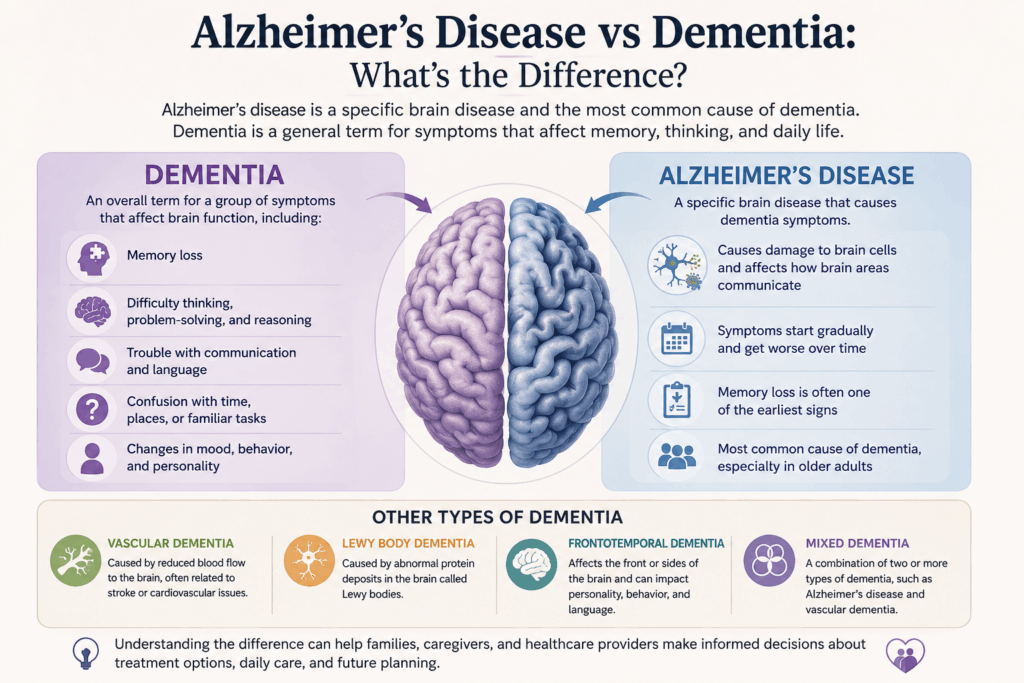
Dementia is a broad term used to describe a group of symptoms that affect memory, thinking, reasoning, communication, and the ability to manage daily life. It is not a specific disease itself, but rather an umbrella term for cognitive decline severe enough to interfere with everyday functioning.
Alzheimer’s disease, on the other hand, is a specific brain disease — and the most common cause of dementia.
In simple terms:
- dementia describes the symptoms
- Alzheimer’s disease is one condition that causes those symptoms
This distinction is important because several different conditions can cause dementia, and each type may progress differently or require different approaches to care and treatment.
Other common types of dementia include:
- vascular dementia
- Lewy body dementia
- frontotemporal dementia
- mixed dementia
While many forms of dementia share similar symptoms, Alzheimer’s disease is typically associated with gradual memory loss, confusion, changes in thinking, and progressive decline over time.
Understanding the difference between Alzheimer’s and dementia can help families better navigate medical evaluations, treatment discussions, caregiving decisions, and long-term care planning.
Early Signs and Symptoms of Alzheimer’s Disease
One of the most common questions families ask is:
What are the first signs of Alzheimer’s disease?
Early symptoms of Alzheimer’s disease often develop gradually and may initially appear mild, inconsistent, or easy to dismiss. In many cases, family members or close friends notice subtle changes before the individual recognizes them themselves.
Because symptoms can resemble normal aging at first, many families are unsure when occasional forgetfulness may be something more serious. The difference is that Alzheimer’s related changes typically become more persistent over time and gradually begin interfering with everyday life, routines, communication, and decision-making.
Common early signs and symptoms of Alzheimer’s may include:
Memory Loss That Disrupts Daily Life
Occasional forgetfulness can happen as people age. However, memory loss related to Alzheimer’s disease is usually more ongoing and disruptive to daily functioning.
Families may notice someone:
- repeatedly asking the same questions
- forgetting recently learned information
- relying heavily on notes, reminders, or family members
- missing appointments or important events
- forgetting conversations or repeating stories shortly afterward
Short-term memory challenges are often among the earliest and most noticeable symptoms.
Difficulty Completing Familiar Tasks
People living with early Alzheimer’s may begin struggling with routines and activities they previously handled independently.
This may include difficulty:
- preparing familiar meals
- managing medications
- paying bills or balancing finances
- following directions
- operating household appliances
- keeping track of steps in routine tasks
Tasks that once felt automatic may gradually become confusing or overwhelming.
Confusion About Time or Place
Individuals may begin losing track of dates, seasons, schedules, or the passage of time. Some may become confused about where they are, how they arrived somewhere, or why they entered a particular room.
In some cases, people may feel disoriented even in places that were once very familiar.
Trouble Finding Words or Following Conversations
Communication changes are also common in the early stages of Alzheimer’s disease.
Families may notice someone:
- struggling to find the right words
- pausing frequently during conversations
- losing track of discussions
- repeating themselves often
- calling objects by incorrect names
- having difficulty following or joining conversations
These communication challenges can sometimes lead to frustration, embarrassment, or social withdrawal.
Changes in Mood, Personality, or Behavior
Alzheimer’s disease can also affect emotional regulation and behavior.
Families sometimes notice:
- increased anxiety or fearfulness
- irritability or frustration
- withdrawal from hobbies or social activities
- depression or sadness
- confusion in unfamiliar situations
- suspicion or mistrust of others
- emotional outbursts or mood swings
These changes may appear gradually and can be especially difficult for loved ones to understand at first.
Poor Judgment or Decision-Making
Some individuals may begin showing noticeable changes in judgment, reasoning, or safety awareness.
Examples may include:
- unusual financial decisions
- difficulty recognizing scams or fraud
- neglecting personal hygiene
- unsafe driving decisions
- forgetting to turn off appliances
- wearing inappropriate clothing for the weather or situation
These changes can increase safety concerns and may signal a growing need for additional support or supervision.
While experiencing one or two of these symptoms does not automatically mean someone has Alzheimer’s, persistent or worsening cognitive changes should not be ignored. Seeking medical evaluation earlier can help families better understand what is happening, access support services sooner, and begin planning for future care needs with greater clarity and confidence.
When Should Someone Be Evaluated for Alzheimer’s Disease?
Many families are unsure when memory changes may be serious enough to discuss with a doctor. Because occasional forgetfulness can happen with normal aging, it is common for people to delay seeking medical evaluation at first.
However, persistent or worsening cognitive changes should not be ignored — especially when they begin affecting daily life, safety, communication, or independence.

A medical evaluation may be important when someone begins experiencing:
- repeated memory problems
- increasing confusion or disorientation
- changes in judgment or decision-making
- difficulty managing medications, finances, or daily tasks
- personality or behavioral changes
- trouble following conversations or expressing thoughts
- wandering, getting lost, or safety concerns
- increasing dependence on family members
In many cases, loved ones notice changes before the individual recognizes them themselves. Families should trust their instincts if something feels noticeably different or progressively worsening over time.
Seeking evaluation earlier can help rule out other possible medical conditions, provide clarity about symptoms, and allow families to begin planning and accessing support services sooner if needed.
Even when Alzheimer’s disease is diagnosed, an earlier diagnosis often gives individuals and families more time to:
- understand available treatment options
- establish legal and financial plans
- create safer routines and living environments
- discuss future care preferences
- build a stronger support system before caregiving needs become more
While these conversations can feel emotional or overwhelming, seeking help earlier often reduces uncertainty and helps families move forward with greater understanding, preparation, and support.
What Causes Alzheimer’s Disease?
Researchers are still working to fully understand the exact causes of Alzheimer’s disease. While there is no single known cause, experts believe the condition develops from a combination of genetic, biological, environmental, and lifestyle-related factors that gradually affect brain health over time.
In Alzheimer’s disease, changes within the brain slowly damage and destroy brain cells, interfering with memory, thinking, communication, and daily functioning.
Several factors are believed to contribute to the development of Alzheimer’s, including:
- age-related changes in the brain
- genetics and family history
- abnormal protein buildup in the brain
- chronic inflammation
- vascular and cardiovascular health conditions
- lifestyle and environmental influences
One of the most recognized biological features of Alzheimer’s involves abnormal protein deposits in the brain known as amyloid plaques and tau tangles. These proteins are believed to disrupt communication between brain cells and eventually contribute to cell damage and cognitive decline.
Although age is the greatest known risk factor, Alzheimer’s disease is not considered a normal part of aging. Many older adults experience mild forgetfulness over time, but the disease causes progressive cognitive changes that interfere with everyday life and independence.
Researchers also continue studying how overall health may influence brain function as people age. Conditions such as high blood pressure, diabetes, heart disease, obesity, smoking, poor sleep, and limited physical activity may increase the risk of cognitive decline in some individuals.
According to the Centers for Disease Control and Prevention (CDC), maintaining heart health, regular physical activity, social connection, quality sleep, and mental stimulation may help support overall brain health and healthy aging.
While there is currently no guaranteed way to prevent this condition, healthy lifestyle habits and earlier medical evaluation may help individuals better manage risk factors and recognize cognitive changes sooner.
Common Misunderstandings About Alzheimer’s Disease
There are many misconceptions surrounding Alzheimer’s disease, and these misunderstandings can sometimes delay diagnosis, increase stigma, or make the caregiving journey even more overwhelming for families.
Understanding the facts about this condition can help families respond with greater compassion, seek support earlier, and make more informed care decisions over time.
Alzheimer’s Disease Is Not a Normal Part of Aging
One of the most common misunderstandings is that significant memory loss is simply a normal part of getting older.
While mild forgetfulness can happen with aging, Alzheimer’s disease causes ongoing cognitive decline that gradually interferes with daily life, communication, judgment, safety, and independence.
Repeated confusion, worsening memory loss, personality changes, and difficulty managing familiar tasks should not be dismissed as “just aging.”
Memory Loss Does Not Always Mean Alzheimer’s Disease
Although Alzheimer’s disease is the most common cause of dementia, not all memory problems are caused by this disease.
Certain medical conditions, medication side effects, sleep disorders, depression, vitamin deficiencies, infections, and other neurological conditions can sometimes cause symptoms that resemble dementia.
This is one reason why proper medical evaluation is so important when cognitive changes begin appearing.
People With Alzheimer’s Can Still Experience Joy and Connection
A diagnosis of Alzheimer’s does not mean a person immediately loses their identity, emotions, or ability to experience meaningful moments.
Even as memory and communication change, many individuals living with Alzheimer’s disease continue to enjoy:
- music
- familiar routines
- family visits
- companionship
- hobbies and activities
- laughter and emotional connection
Compassion, patience, reassurance, and supportive environments can continue to provide comfort and quality of life throughout the progression of the disease.
Early Support Can Make a Meaningful Difference
Some families avoid discussing symptoms or seeking help because they fear the diagnosis or feel unsure about what comes next.
However, early support and planning can often improve safety, reduce stress, and help families access valuable medical, emotional, and caregiving resources sooner.
Seeking help earlier does not mean giving up independence. In many cases, it allows individuals and families to make thoughtful decisions, establish support systems, and prepare gradually rather than waiting for a crisis situation to occur.
The Stages of Alzheimer’s Disease
Alzheimer’s disease typically progresses gradually over time, with symptoms becoming more noticeable as the condition advances. Although every person experiences this condition differently, the disease is commonly described in three broad stages: early-stage, middle-stage, and late-stage Alzheimer’s disease.
As cognitive and physical changes increase, the level of support needed for daily life and personal care often increases as well.
Early-Stage Alzheimer’s Disease
During the early stage of Alzheimer’s disease, many individuals are still able to live independently and participate in most daily activities. However, subtle cognitive changes often begin affecting memory, organization, communication, and routine tasks.
Common symptoms during the early stage may include:
- mild but persistent memory loss
- forgetting appointments or conversations
- difficulty organizing or planning tasks
- frequently misplacing items
- trouble finding words during conversations
- increased confusion in unfamiliar environments
- difficulty concentrating or following complex instructions
At this stage, symptoms are often mild enough that friends or family members may initially mistake them for normal aging or stress-related forgetfulness.
Many individuals continue driving, socializing, and managing daily routines, although they may begin relying more heavily on reminders, calendars, notes, or support from loved ones.
Because symptoms are still relatively mild, early-stage Alzheimer’s disease is often an important time for:
- medical evaluation and diagnosis
- future care planning
- legal and financial discussions
- establishing routines and support systems
Middle-Stage Alzheimer’s Disease
The middle stage is often the longest stage of Alzheimer’s disease and may involve more noticeable cognitive, behavioral, emotional, and physical changes.
As the disease progresses, individuals typically require increasing support with everyday activities and personal care.
Families may begin noticing:
- increased confusion and disorientation
- wandering or getting lost
- sleep disturbances
- personality or behavioral changes
- mood swings, anxiety, or agitation
- difficulty recognizing familiar people
- challenges with communication
- assistance needed with dressing, bathing, or meals
- growing difficulty managing household tasks and daily routines
During this stage, caregiving responsibilities often become significantly more demanding, both emotionally and physically.
Many families begin exploring additional support services such as:
- home health care
- adult day programs
- respite care
- memory care communities
- residential care homes

Some families may also consider transitioning from independent living environments into settings that offer more structured supervision and dementia-specific support.
Families comparing care options may find these resources helpful:
Late-Stage Alzheimer’s Disease
In the later stage of Alzheimer’s disease, individuals typically require extensive assistance with nearly all aspects of daily life and personal care.
As brain function continues to decline, communication, mobility, and physical health often become increasingly affected.
Symptoms during the late stage may include:
- severe memory loss
- limited or minimal verbal communication
- difficulty swallowing
- inability to walk independently
- increased frailty and weakness
- loss of awareness of surroundings
- increased vulnerability to infections and medical complications
- full assistance needed with bathing, dressing, eating, and mobility
At this stage, caregiving needs are often complex and may require around-the-clock supervision or professional medical support.
Families frequently rely on skilled caregivers, nursing support, or specialized long-term care services to help manage safety, comfort, nutrition, mobility, and overall quality of life.
In some situations, hospice care may also become appropriate when the focus shifts toward comfort, symptom management, and emotional support near the end of life.
Families exploring advanced care options may also want to learn more about:
It is important to remember that Alzheimer’s disease progresses differently for every individual. Some people experience slower changes over many years, while others decline more rapidly. Regardless of the stage, compassionate support, structured routines, medical guidance, and early care planning can help improve quality of life for both individuals living with progressive memory loss and the families caring for them.
How Alzheimer’s Disease Affects Daily Life
Alzheimer’s disease affects far more than memory alone. As the condition progresses, it can gradually impact nearly every aspect of daily life, including communication, routines, independence, safety, and personal relationships.
Tasks that once felt simple and automatic may slowly become confusing, overwhelming, or difficult to manage independently.
Over time, individuals living with Alzheimer’s may begin struggling with:
- preparing meals
- managing medications
- driving safely
- maintaining personal hygiene
- dressing appropriately for the weather or situation
- handling finances and household responsibilities
- following conversations or expressing thoughts clearly
- recognizing safety concerns or emergency situations
Even familiar routines may become harder to follow as memory, judgment, problem-solving, and concentration decline.
In many cases, these changes happen gradually. Families often begin by offering occasional reminders or assistance, but caregiving responsibilities may steadily increase over time.
Beyond the physical and cognitive challenges, Alzheimer’s disease can also deeply affect emotional well-being and family dynamics. Individuals may feel frustrated, embarrassed, anxious, or fearful as they become aware of changes in their abilities. At the same time, loved ones often experience sadness, stress, uncertainty, and emotional exhaustion while trying to provide support.
Many families also experience a gradual role reversal as adult children, spouses, or other loved ones begin taking on caregiving responsibilities, managing appointments, overseeing finances, coordinating care, and helping make important decisions.
As support needs increase, families may eventually need to consider additional resources such as home health care, respite support, adult day programs, memory care communities, or other long-term care services to help maintain safety, structure, and quality of life.
Behavioral and Emotional Changes Families May Notice
One of the most emotionally difficult aspects of Alzheimer’s disease for families is the behavioral, emotional, and personality changes that can occur as the condition progresses.
Because this condition affects areas of the brain responsible for memory, communication, judgment, emotional regulation, and perception, individuals may sometimes behave in ways that feel unfamiliar, confusing, or distressing to loved ones.
People living with Alzheimer’s may experience:
- agitation or restlessness
- fear, anxiety, or increased nervousness
- confusion or disorientation
- frustration and irritability
- emotional outbursts or mood swings
- paranoia, suspicion, or mistrust
- wandering or attempts to leave home unexpectedly
- sleep disturbances or nighttime confusion
- withdrawal from social activities or conversations
These changes may fluctuate from day to day and are often more noticeable as cognitive decline progresses.
For many families, it can be especially painful to witness shifts in personality, communication, or emotional responses in someone they love. A person who was once calm and independent may become fearful, suspicious, withdrawn, or easily overwhelmed as the disease affects their ability to process information and understand their surroundings.
In some cases, behaviors are triggered by unmet physical or emotional needs such as pain, fatigue, overstimulation, hunger, loneliness, unfamiliar environments, or difficulty communicating discomfort.
Understanding that these behaviors are symptoms of the disease — rather than intentional actions or personal choices — can help families respond with greater patience, empathy, and compassion.
Creating calm routines, reducing stress, offering reassurance, and maintaining a safe and supportive environment may help reduce anxiety and confusion for some individuals living with cognitive decline.
Families looking for caregiving support and practical guidance can also explore the Alzheimer’s Association Caregiver Center, which offers educational resources, caregiving strategies, emotional support, and information for families navigating Alzheimer’s care.
How Alzheimer’s Disease Is Diagnosed
There is no single test that can definitively diagnose Alzheimer’s disease. Instead, doctors use a combination of medical evaluations, cognitive assessments, and diagnostic tools to better understand a person’s symptoms and rule out other possible causes of memory loss or cognitive decline.

Because several medical conditions can cause symptoms that resemble dementia, obtaining a thorough medical evaluation is extremely important.
Doctors may evaluate:
- medical history and overall health
- memory and cognitive functioning
- physical and neurological health
- changes in behavior, communication, and daily functioning
- medications and possible side effects
- family history and risk factors
Diagnostic testing may also include:
- memory and cognitive assessments
- physical examinations
- neurological evaluations
- brain imaging such as MRI or CT scans
- bloodwork and laboratory testing
In many cases, doctors also speak with close family members or caregivers, since loved ones often notice behavioral or cognitive changes that the individual may not fully recognize themselves.
The diagnostic process can sometimes feel overwhelming or emotional for families. However, seeking evaluation earlier can provide valuable clarity and help families better understand what may be causing the symptoms.
An early diagnosis of Alzheimer’s disease may help families:
- better understand cognitive and behavioral changes
- plan for future care needs
- access medical care and support services sooner
- establish legal and financial plans earlier
- discuss healthcare wishes and long-term goals
- explore available treatments, therapies, and caregiving resources
Even though receiving a diagnosis can be difficult, earlier planning often gives individuals and families more time to make informed decisions, build support systems, and prepare for future changes with greater confidence and stability.
Treatment and Support Options for Alzheimer’s Disease
Although there is currently no cure for Alzheimer’s disease, treatment and supportive care can help manage symptoms, improve comfort, and enhance quality of life for both individuals living with the disease and the families caring for them.
Treatment plans are often personalized based on a person’s stage of Alzheimer’s disease, overall health, symptoms, and level of daily support needed.
Depending on the individual’s needs, treatment and support may include:
- medications to help manage memory or cognitive symptoms
- cognitive stimulation and mental engagement activities
- regular physical activity and movement
- structured daily routines
- nutritional support and hydration monitoring
- occupational, physical, or speech therapy
- emotional and behavioral support
- caregiver education and guidance
While medications may help some individuals manage certain symptoms temporarily, supportive care remains one of the most important parts of Alzheimer’s care.
Consistent routines, calm environments, familiar surroundings, and clear communication can often help reduce confusion, anxiety, frustration, and emotional distress. Small adjustments to the home environment may also improve safety and daily functioning as the disease progresses.
Because Alzheimer’s disease affects the entire family, many caregivers also benefit from additional emotional and practical support throughout the caregiving journey.
Families may find support through:
- caregiver support groups
- counseling services
- respite care programs
- adult day services
- community resources and educational programs
- in-home caregiving assistance
As support needs increase over time, some families may also explore professional long-term care services that provide more structured supervision and specialized dementia support.
Some families eventually explore specialized Memory Care communities or Residential Care Homes as support needs increase.
Seeking help earlier does not mean giving up independence. In many situations, additional support can improve safety, reduce caregiver stress, and help individuals living with Alzheimer’s disease maintain the highest possible quality of life for as long as possible.
Caring for Someone with Alzheimer’s Disease
Caring for someone with Alzheimer’s disease can be one of the most meaningful — and most demanding — responsibilities a family may experience. As the disease progresses, caregiving often becomes increasingly physical, emotional, and mentally exhausting over time.
The impact of Alzheimer’s disease extends far beyond the individual living with the condition. The Alzheimer’s Association reports that millions of family members and unpaid caregivers across the United States provide ongoing care and support for loved ones living with Alzheimer’s disease and other forms of dementia each year.

In the early stages, support may involve simple reminders, transportation assistance, or help organizing daily routines. However, as cognitive decline increases, caregivers frequently take on a much larger role in managing safety, personal care, communication, and everyday decision-making.
Caregivers often help with:
- medication management
- meals, hydration, and nutrition
- bathing and dressing
- transportation and appointments
- supervision and home safety
- emotional reassurance and companionship
- communication support
- managing behavioral changes and confusion
Because Alzheimer’s disease affects memory, reasoning, judgment, and behavior, caregiving responsibilities can gradually become unpredictable and emotionally overwhelming.
Many family caregivers experience:
- chronic stress
- sleep deprivation
- emotional exhaustion
- caregiver burnout
- anxiety or depression
- social isolation
- feelings of guilt, grief, or helplessness
For many families, one of the hardest parts of Alzheimer’s caregiving is watching a loved one slowly lose independence while caregiving responsibilities steadily increase.
Because these changes often happen gradually, families sometimes underestimate how much support will eventually be needed. What begins as occasional assistance may slowly evolve into around-the-clock supervision and full personal care support.
Seeking help earlier can make a meaningful difference for both the individual living with Alzheimer’s disease and the caregiver providing support. Additional resources, respite care, support groups, home health services, and long-term care planning can help reduce crisis situations, improve safety, and ease caregiver stress before exhaustion becomes overwhelming.
It is also important for caregivers to care for their own physical and emotional well-being. Caregivers who receive support themselves are often better able to provide compassionate, sustainable care over time.
Families navigating the emotional challenges of caregiving may also benefit from reading:
- Family Caregiver Burnout: Warning Signs, Causes, and Support Every Caregiver Needs
- Senior Care Planning: How to Plan for Long-Term Care Before a Crisis Happens
When Memory Care May Become Necessary
Many families caring for someone with Alzheimer’s disease eventually wonder when it may be time to consider memory care or additional long-term care support.
This decision is often emotional and deeply personal. In many cases, families try to provide support at home for as long as possible. However, as Alzheimer’s disease progresses, caregiving needs can gradually become more complex, demanding, and difficult to manage safely without additional help.
There is no single “right” timeline for transitioning to memory care. Every situation is different. However, additional support may become necessary when:
- safety concerns increase
- wandering or getting lost becomes more common
- medication management becomes difficult
- daily activities require extensive assistance
- behavioral symptoms become difficult to manage at home
- nighttime confusion or sleep disturbances increase
- caregiving responsibilities become physically or emotionally overwhelming
- a loved one can no longer be safely left alone
For many families, the decision to explore memory care is not about giving up. It is about ensuring safety, stability, specialized support, and quality of life for both the individual living with Alzheimer’s disease and the family providing care.
Memory care communities are specifically designed to support individuals living with Alzheimer’s disease and other forms of dementia. These environments typically offer structured routines, secured spaces, trained staff, and specialized support focused on cognitive decline, safety, and emotional well-being.
Memory care communities often provide:
- structured daily routines
- secured and monitored environments
- dementia-trained caregivers and staff
- therapeutic and social engagement activities
- medication management and support
- assistance with daily living activities
- 24/7 supervision and care
For some individuals, transitioning into memory care can also reduce anxiety and confusion by providing more consistency, routine, and specialized support throughout the day.
Families exploring long-term care support can compare providers, services, and care options directly through longtermcarefinder.com to help find the level of support that best matches their loved one’s needs, preferences, and stage of care.
How Families Can Plan Ahead Earlier
One of the most important things families can do after an Alzheimer’s diagnosis is begin planning ahead as early as possible. While these conversations can feel emotional or difficult at first, planning earlier often gives families more time, flexibility, and peace of mind as future needs change.
In the early stages of Alzheimer’s disease, many individuals are still able to participate in important discussions about their wishes, preferences, values, and future care decisions.

Having these conversations sooner can help families make more informed and confident decisions later on.
Early planning may include conversations about:
- future care preferences
- financial planning and budgeting
- legal documents and power of attorney
- healthcare wishes and medical decisions
- living arrangements and long-term care options
- caregiving roles and family expectations
- home safety and support needs
Planning ahead can also help reduce stress during future medical emergencies or caregiving crises. When families wait until a situation becomes urgent, decisions often need to be made quickly and under emotional pressure.
Even small conversations today can make a meaningful difference later. Discussing goals, concerns, and available support options earlier may help families feel more prepared, organized, and emotionally supported as the disease progresses.
Many families also find it helpful to gradually explore available long-term care resources before immediate care becomes necessary. Understanding options ahead of time can make future transitions feel less overwhelming if additional support is eventually needed.
Final Thoughts
Alzheimer’s disease affects far more than memory alone. Over time, it can influence communication, daily routines, relationships, independence, emotional well-being, and nearly every aspect of everyday life for both individuals living with the disease and the families caring for them.
For many families, the journey can feel emotional, uncertain, and overwhelming at times. The changes often happen gradually, making it difficult to know what to expect or when additional support may become necessary. But understanding Alzheimer’s disease, recognizing symptoms earlier, and seeking guidance along the way can help families make more informed, compassionate, and confident decisions throughout the caregiving journey.
Although there is currently no cure for Alzheimer’s disease, early planning, structured routines, supportive environments, and strong caregiving support can make a meaningful difference in comfort, safety, and overall quality of life.
It is also important for families to remember that they do not have to navigate Alzheimer’s disease alone. Support may come through healthcare professionals, community resources, caregiver groups, home health services, memory care programs, or long-term care providers that specialize in dementia support.
Whether a loved one is experiencing early memory changes or requires more advanced care and supervision, exploring support options earlier can help reduce stress and create a more stable, compassionate care plan over time.
At longtermcarefinder.com, families can explore memory care communities, home health care services, residential care homes, hospice providers, and other long-term care options — helping them compare services, understand different levels of care, and connect directly with providers that match their loved one’s needs, preferences, and level of support. While Alzheimer’s disease can change many parts of life, compassionate support, meaningful connection, and thoughtful care can continue to bring comfort, dignity, and moments of joy throughout the journey.
Frequently Asked Questions About Alzheimer’s Disease
Families navigating Alzheimer’s disease often have many questions about symptoms, diagnosis, caregiving, memory care, and long-term support options. Below are answers to some of the most common questions families ask when learning more about this disease and dementia care.
What is Alzheimer’s disease?
Alzheimer’s disease is a progressive brain disorder that gradually affects memory, thinking, communication, behavior, and the ability to carry out everyday tasks. It is the most common cause of dementia in older adults.
What are the early signs of Alzheimer’s disease?
Early signs of Alzheimer’s disease may include persistent memory loss, repeated questions, difficulty completing familiar tasks, confusion about time or place, trouble finding words, mood changes, and poor judgment or decision-making.
What is the difference between Alzheimer’s disease and dementia?
Dementia is a broad term used to describe symptoms that affect memory, thinking, and daily functioning. Alzheimer’s disease is a specific brain disease and the most common cause of dementia.
Is Alzheimer’s disease a normal part of aging?
No. While mild forgetfulness can happen with aging, Alzheimer’s disease causes ongoing cognitive decline that gradually interferes with daily life, communication, safety, and independence.
What causes Alzheimer’s disease?
Researchers believe Alzheimer’s disease develops from a combination of factors, including age-related brain changes, genetics, abnormal protein buildup in the brain, inflammation, cardiovascular health conditions, and lifestyle influences.
How is Alzheimer’s disease diagnosed?
Doctors typically diagnose Alzheimer’s disease through medical history reviews, memory and cognitive testing, physical and neurological evaluations, brain imaging, and laboratory testing to rule out other possible causes of symptoms.
Can Alzheimer’s disease be cured?
There is currently no cure for Alzheimer’s disease. However, medications, supportive care, structured routines, therapies, and caregiving support may help manage symptoms and improve quality of life.
What are the stages of Alzheimer’s disease?
Alzheimer’s disease is commonly divided into three broad stages:
- early-stage Alzheimer’s disease
- middle-stage Alzheimer’s disease
- late-stage Alzheimer’s disease
Symptoms and support needs typically increase as the disease progresses over time.
When should someone with Alzheimer’s disease stop living alone?
Additional support may become necessary when safety concerns increase, wandering occurs, medications are not managed properly, daily activities become difficult, or a person can no longer safely care for themselves independently.
What is memory care?
Memory care is a specialized form of long-term care designed for individuals living with Alzheimer’s disease and other forms of dementia. Memory care communities typically provide secured environments, structured routines, dementia-trained staff, medication support, and 24/7 supervision.
When is it time to consider memory care?
Families may begin considering memory care when caregiving demands become overwhelming, safety concerns increase, wandering becomes more common, or a loved one requires more supervision and support than can safely be provided at home.
How can families support someone living with Alzheimer’s disease?
Families can support someone living with Alzheimer’s disease by maintaining calm routines, providing reassurance, simplifying communication, creating safe environments, encouraging social connection, and seeking caregiving support before burnout becomes overwhelming.
How can caregivers avoid burnout?
Caregivers can help reduce burnout by accepting support from others, using respite care services, joining caregiver support groups, prioritizing rest and self-care, and seeking professional help when stress becomes overwhelming.
Where can families find Alzheimer’s care and support services?
Families can explore memory care communities, home health care services, residential care homes, hospice providers, and other long-term care options through longtermcarefinder.com to compare providers and find support that matches their loved one’s needs and level of care.