
“I feel like my dad is dying of starvation.”
Those heartbreaking words are spoken by many family caregivers watching a loved one with Alzheimer’s disease or another form of dementia gradually stop eating and drinking.
For weeks or even months, meals become increasingly difficult. A loved one may refuse food, pocket it in their cheeks, forget how to use utensils, turn their head away from every bite, or refuse even a sip of water. Families often feel helpless as they watch someone they love eat less and less.
It’s natural to wonder, “Can someone with dementia starve to death?” You may also wonder whether you should keep encouraging, persuading, or even forcing your loved one to eat.
The truth is often very different from what families fear.
In advanced dementia, the brain gradually loses the ability to control many of the complex functions required for eating and drinking safely. The National Institute on Aging explains that eating and swallowing problems commonly develop as dementia progresses, particularly during the later stages of the disease.
As the disease progresses, the body’s need for food also changes. In many cases, eating less is not the cause of death but rather a sign that the disease is reaching its final stages.
Understanding why this happens can help replace fear, guilt, and uncertainty with knowledge and compassion, allowing families to focus on comfort and quality of life.
Important: Every person’s experience with dementia is different. This article is intended for educational purposes and should not replace medical advice from your loved one’s physician or healthcare team. If your loved one suddenly stops eating or drinking, contact their healthcare provider promptly.
Quick Answer
No, not in the way most families imagine.
People with advanced dementia generally do not die because they intentionally starve themselves. Instead, the disease gradually damages the brain areas responsible for recognizing hunger, coordinating chewing and swallowing, remembering how to eat, and signaling thirst.
As the body begins to shut down during the final stages of dementia, it naturally requires less food and water. Reduced eating and drinking are usually part of the dying process rather than its cause.
Although watching this happen can be heartbreaking, forcing food or fluids often does not improve comfort and may even increase the risk of choking, aspiration pneumonia, nausea, or distress.
Quick Facts at a Glance
- Advanced dementia is a terminal brain disease. As the disease progresses, the brain gradually loses the ability to control eating, swallowing, hunger, and thirst.
- Most people with advanced dementia are not intentionally starving themselves. Reduced eating and drinking are usually part of the disease’s natural progression rather than the primary cause of death.
- Forcing food or fluids may do more harm than good. It can increase the risk of choking, aspiration pneumonia, and discomfort when the body can no longer process food normally.
- Feeding tubes are not routinely recommended for advanced dementia. Research has shown they generally do not improve survival, prevent aspiration pneumonia, or improve quality of life in people with advanced dementia.
- Hospice continues to offer food and fluids when they are wanted and can be swallowed safely. The focus is on comfort, dignity, and honoring the person’s wishes—not withholding care.
- Your presence is one of the greatest gifts you can give. Even when your loved one no longer wants to eat, sitting with them, holding their hand, speaking gently, and providing comfort remain meaningful acts of love.
Why Families Feel Like Their Loved One Is Starving
One of the most difficult parts of caring for someone with advanced dementia is that our instincts tell us food equals life.
Since childhood, we’ve learned that feeding someone is one of the most basic ways to care for them. When someone refuses food, it feels as though they’re slowly starving.
Family members often experience thoughts like:
- “If I could just get her to eat one more meal…”
- “Maybe she just hasn’t found something she likes.”
- “She’s going to die because she won’t eat.”
- “Am I giving up if I stop encouraging her?”
- “Am I letting her starve?”
These feelings are incredibly common—and they come from love.
But advanced dementia changes the body in ways that make eating very different from what healthy people experience.
The challenge is usually not a lack of effort by the caregiver. Instead, it is the progression of a disease that is affecting the brain’s ability to eat safely and the body’s natural need for nutrition.
Common Family Fears vs. What Is Usually Happening in Advanced Dementia
During the final stages of dementia, it’s easy to feel overwhelmed by fear, guilt, and uncertainty. Many caregivers worry that every missed meal means they are failing their loved one. The following table addresses some of the most common fears families experience and explains what is usually happening as dementia progresses.
| Common Family Fear | What Is Usually Happening in Advanced Dementia |
| “My mom is starving to death.” | In advanced dementia, the brain gradually loses the ability to regulate hunger, thirst, chewing, and swallowing. Eating less is usually part of the disease’s progression rather than the cause of death. |
| “If I don’t make her eat, she’ll die.” | As the body naturally begins to shut down, it requires less food and fluid. Encouraging food is appropriate when it can be eaten safely, but forcing food often does not change the course of the disease and may increase the risk of choking or aspiration. |
| “She’s giving up.” | People with advanced dementia are not choosing to stop eating. The disease affects the brain’s ability to recognize hunger, process food, and coordinate the complex actions needed to eat and drink. |
| “She’s doing this on purpose.” | Refusing food is rarely a conscious decision. Brain changes, swallowing difficulties, reduced appetite, and decreased awareness often make eating difficult or uncomfortable. |
| “Maybe she’s just being stubborn.” | What may look like stubbornness is often the result of confusion, fear, difficulty recognizing food, or an inability to understand what is being asked. |
| “I’m failing as a caregiver.” | Your role changes as dementia progresses. When eating becomes difficult, providing comfort, respecting your loved one’s cues, and following guidance from the healthcare team are compassionate forms of care—not signs of giving up. |
| “If we choose hospice, they’ll stop feeding her.” | Hospice does not stop offering food or water. Hospice encourages eating and drinking whenever the person wants and can do so safely. The focus is on comfort, dignity, and honoring the person’s wishes. |
| “A feeding tube will fix the problem.” | A feeding tube cannot stop the progression of dementia or restore the brain’s ability to eat normally. For many people with advanced dementia, it has not been shown to improve survival or quality of life. Decisions about feeding tubes should always be made with the healthcare team based on the individual’s condition and goals of care. |
How the Brain Controls Eating
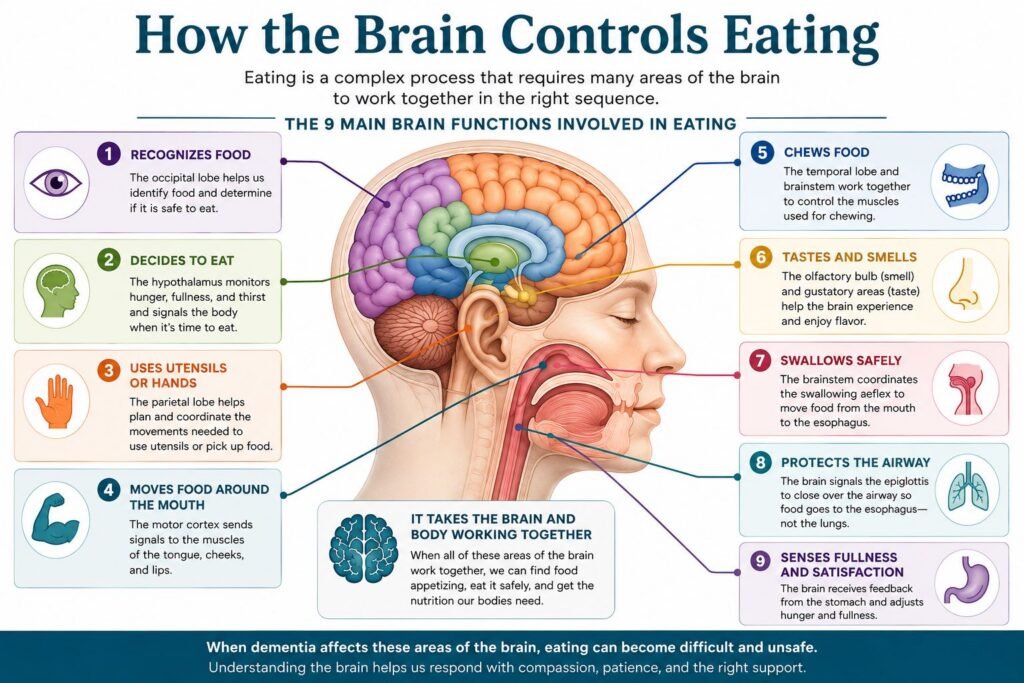
Many people think eating is a simple activity, but it is actually one of the most complex functions the brain performs. Every bite of food requires multiple areas of the brain to work together in perfect coordination. If even one part of this process begins to fail, eating can become difficult, frustrating, or even unsafe.
To eat a single meal, the brain must be able to:
- Recognize that the food is edible.
- Identify it as safe to eat.
- Feel hunger and thirst.
- Remember how to use utensils or pick up food.
- Coordinate hand and arm movements.
- Chew food effectively.
- Move food around the mouth with the tongue.
- Coordinate the swallowing reflex.
- Protect the airway so food enters the esophagus instead of the lungs.
- Recognize when the body has had enough to eat or drink.
In Alzheimer’s disease and other forms of dementia, these brain networks gradually become damaged. As the disease progresses, a person may lose the ability to recognize food, forget how to use utensils, have difficulty chewing or swallowing, or simply no longer feel hungry or thirsty.
This is why many people with advanced dementia stop eating and drinking. It is not usually because they are choosing to stop or because they have “given up.” Instead, the disease is gradually affecting the brain’s ability to perform one of the body’s most basic functions.
Understanding this can help families recognize that their loved one is not refusing food out of stubbornness or a lack of will. They are experiencing the natural progression of a disease that is affecting the brain itself.
Why People with Dementia Stop Eating and Drinking
There is rarely a single reason why someone with advanced dementia stops eating or drinking. Instead, several changes in the brain and body often occur at the same time. These changes gradually make eating more difficult, less comfortable, and eventually impossible.
Understanding these changes can help families realize that their loved one is not choosing to stop eating. The disease itself is affecting the brain’s ability to perform one of life’s most basic functions.
They No Longer Feel Hungry or Thirsty
The brain contains specialized areas that regulate hunger and thirst. As dementia progresses, these areas may no longer function properly.
A person may simply stop experiencing hunger or thirst the way they once did. They may not ask for food, request a drink, or recognize the physical sensations that normally remind us to eat and stay hydrated.
For family members, this can be especially difficult because it seems impossible to imagine not feeling hungry. However, reduced appetite is a common part of advanced dementia and, later in the disease, the body’s natural slowing as it approaches the end of life.
They Forget How to Eat
Eating is a learned skill that most of us perform automatically. We rarely think about how to hold a fork, scoop food onto a spoon, or bring a cup to our mouth.
For someone with advanced dementia, these familiar tasks may no longer make sense.
They may:
- Forget how to use utensils.
- Be unable to coordinate the movements needed to eat.
- Hold food without knowing what to do next.
- Stop eating midway through a meal because they no longer remember they were eating.
This is not laziness or stubbornness. It is the result of damage to the parts of the brain responsible for planning and coordinating everyday activities.
Swallowing Becomes More Difficult
One of the most significant changes in advanced dementia is the gradual loss of the ability to swallow safely.
Swallowing is an incredibly complex process involving dozens of muscles and several areas of the brain. As dementia damages these brain pathways, swallowing may become slower, less coordinated, and less effective.
A person may:
- Cough or choke during meals.
- Hold food in their mouth without swallowing, a behavior known as food pocketing.
- Take much longer to finish meals.
- Refuse food because swallowing has become uncomfortable or frightening.
Healthcare professionals refer to difficulty swallowing as dysphagia. Dysphagia increases the risk of choking, dehydration, poor nutrition, and aspiration pneumonia, which occurs when food or liquids enter the lungs instead of the stomach.
Food May No Longer Look Familiar
Advanced dementia can affect the brain’s ability to recognize everyday objects, including food.
A person may look at a plate of food without understanding what it is or what they are supposed to do with it. They may mistake mashed potatoes for something else, fail to recognize a spoon, or become confused by foods they once enjoyed.
Visual and cognitive changes can also make colorful or cluttered plates overwhelming, causing the person to lose interest in eating altogether.
Taste and Smell May Change
Dementia can also affect the senses of taste and smell.
Foods that were once favorites may suddenly seem bland, unfamiliar, or unpleasant. Some people develop a preference for sweet foods, while others lose interest in eating almost entirely.
These sensory changes can further reduce appetite and make it even more challenging for caregivers to encourage regular meals.
The Body Naturally Needs Less Food Near the End of Life
As dementia reaches its final stages, the body’s metabolism gradually slows.
The body begins using less energy, digestion becomes less efficient, and the need for calories and fluids decreases. This is a natural part of the dying process that occurs in many terminal illnesses, not only dementia.
Although this can be heartbreaking to witness, reduced eating and drinking during this stage are usually signs that the body is slowing down rather than signs that the person is suffering from starvation.
Understanding this difference can help families shift their focus from trying to increase food intake to providing comfort, dignity, and companionship during the time they have together.
How Eating Often Changes as Dementia Progresses
Every person’s experience with dementia is unique, and these changes do not occur at the same pace or in the same order. The following timeline shows how eating and drinking often change as dementia progresses.
| Earlier Stages | Middle Stages | Advanced Stages |
| Occasionally forgets meals | Needs reminders to eat | Rarely feels hungry |
| Eats more slowly | Needs help using utensils | Difficulty chewing |
| Appetite mostly normal | May pocket food | Difficulty swallowing |
| Can eat independently | Needs meal supervision | Eats only small bites or sips |
Remember: Someone with advanced dementia is usually not refusing food out of choice. The disease is gradually affecting the brain’s ability to recognize hunger, process food, coordinate swallowing, and communicate needs. Understanding these changes can help replace feelings of guilt with compassion and guide families toward comfort-focused care.
Can Someone with Dementia Starve to Death?
This is one of the most painful questions families ask.
When someone with advanced Alzheimer’s disease or another form of dementia gradually stops eating and drinking, it can feel as though they are starving to death. Watching meals become smaller each day and seeing noticeable weight loss naturally leads many caregivers to wonder if they are doing enough.
In most cases, however, the answer is no.
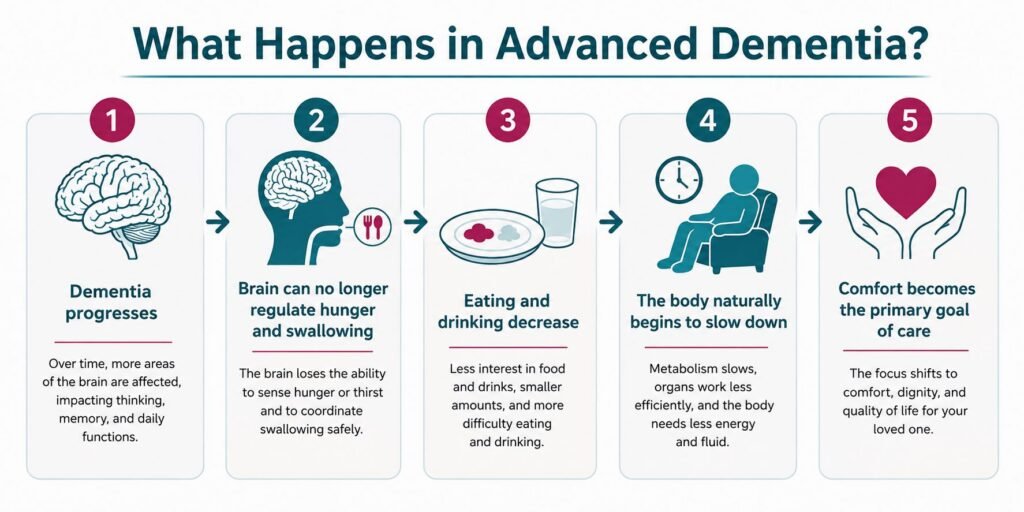
Advanced dementia is a terminal brain disease. As it progresses, the brain gradually loses its ability to regulate hunger and thirst, recognize food, coordinate chewing and swallowing, and communicate the body’s nutritional needs. As a result, food and fluid intake naturally decline.
At the same time, the body itself begins to slow down. Metabolism decreases, digestion becomes less efficient, and the body’s need for calories and fluids becomes much lower than it was earlier in life. These changes are part of the natural dying process and occur in many terminal illnesses, not just dementia.
This means that reduced eating is usually a consequence of the disease’s progression rather than the primary cause of death.
That distinction is important.
Many caregivers carry tremendous guilt, believing their loved one is dying because they could not get them to eat enough. In reality, the dementia is causing the brain and body to gradually shut down. Even with loving care, favorite meals, nutritional supplements, or constant encouragement, there often comes a point when the body is no longer able to use food the way it once did.
Understanding this does not make the experience any less heartbreaking, but it can help families replace feelings of guilt with a better understanding of what is happening. Instead of wondering whether they have failed their loved one, they can focus on providing comfort, dignity, and companionship during this stage of the journey.
Important: If your loved one suddenly stops eating or drinking, or if the change seems unexpected rather than part of a gradual decline, contact their healthcare provider promptly. A sudden loss of appetite or swallowing ability may be caused by a treatable medical condition, such as an infection, medication side effect, dehydration, dental problem, or stroke, rather than the progression of dementia alone.
Should You Force Someone with Dementia to Eat?
Watching someone you love refuse food can trigger an almost instinctive response: “They have to eat.” Many family caregivers spend hours trying different foods, encouraging one more bite, or worrying that they are giving up if they stop insisting.
These feelings are completely understandable. Providing food is one of the most basic ways we care for another person, and it can feel wrong to do anything less.
However, when dementia has reached an advanced stage, forcing someone to eat often does more harm than good.
The brain may no longer be able to coordinate chewing and swallowing safely. A person who is encouraged or pressured to eat may become frightened, cough, choke, or accidentally inhale food or liquids into their lungs, a condition known as aspiration. Aspiration can lead to pneumonia, one of the most common complications of advanced dementia.
Instead of focusing on the amount of food eaten, healthcare providers and hospice teams often encourage families to focus on comfort. This may include offering small bites of favorite foods, providing sips of fluids if they can be swallowed safely, keeping the person’s mouth clean and moist, and accepting that some days they may eat very little.
Following your loved one’s cues does not mean you are giving up. It means you are responding to the changes caused by the disease while helping them remain as comfortable as possible.
What About IV Fluids?
Many families wonder whether intravenous (IV) fluids can prevent dehydration and help their loved one live longer.
Although IV fluids can be lifesaving for someone recovering from an illness or surgery, they are not always beneficial during the final stages of advanced dementia.
As the body begins to shut down, it becomes less able to process extra fluids. In some cases, IV fluids can contribute to swelling in the hands and feet, fluid buildup in the lungs that makes breathing more difficult, or increased secretions that can cause discomfort.
For this reason, the decision to use IV fluids should always be made with the healthcare team after considering your loved one’s overall condition, goals of care, and whether the treatment is likely to improve comfort or address a reversible medical problem.
If a sudden illness, such as an infection, temporarily reduces eating or drinking, the healthcare team may recommend treatments that differ from those used when dementia has reached its final stages.
Do Feeding Tubes Help People with Advanced Dementia?
One of the most difficult decisions families may face is whether to place a feeding tube when a loved one with advanced dementia can no longer eat enough by mouth.
It’s natural to hope that a feeding tube will provide nutrition, prevent starvation, and help a loved one live longer. Many families also believe it will prevent choking or aspiration pneumonia.
However, research has shown that, for most people with advanced dementia, feeding tubes generally do not improve survival, prevent aspiration pneumonia, heal pressure injuries, improve nutritional status in a way that changes the course of the disease, or improve quality of life. Because of this evidence, the American Geriatrics Society recommends against the routine use of feeding tubes for older adults with advanced dementia, noting that careful hand feeding is generally preferred whenever it can be provided safely.
One common misconception is that feeding tubes prevent aspiration pneumonia. Unfortunately, they cannot prevent saliva, stomach contents, or oral secretions from entering the lungs. As a result, aspiration pneumonia can still occur even when nutrition is delivered through a feeding tube.
It’s also important to understand that a feeding tube cannot stop the progression of Alzheimer’s disease or other forms of dementia. Although it delivers nutrition directly to the stomach, it does not restore the brain’s ability to recognize hunger, coordinate swallowing, or reverse the damage caused by the disease.
There are situations in which a feeding tube may be appropriate. For example, someone with a temporary swallowing problem caused by a stroke, certain cancers, or another reversible medical condition may benefit from tube feeding while they recover. Advanced dementia is different because the loss of eating ability is usually part of the disease’s natural progression rather than a temporary problem.
For this reason, many medical organizations recommend careful hand feeding for comfort whenever it can be done safely, rather than routine feeding tube placement for people with advanced dementia. Hand feeding allows caregivers to offer food and fluids based on the person’s interest, comfort, and ability to swallow safely, even if only small amounts are accepted.

The decision to place a feeding tube is deeply personal. It should be made in partnership with your loved one’s physician and healthcare team after discussing the potential benefits, risks, your loved one’s previously expressed wishes, advance directives, and the overall goals of care.
Remember: Because every person’s medical situation is unique, decisions about tube feeding should always be made together with the healthcare team after discussing the potential benefits, risks, and the person’s goals of care.
Feeding Tube vs Comfort-Focused Hand Feeding
| Feeding Tube | Comfort-Focused Hand Feeding |
| Delivers nutrition directly to the stomach. | Offers food and fluids by mouth as tolerated. |
| Does not stop the progression of dementia. | Focuses on comfort and preserving the enjoyment of eating when possible. |
| Does not eliminate the risk of aspiration pneumonia. | Allows caregivers to respond to the person’s cues and stop if eating becomes uncomfortable or unsafe. |
| May be appropriate for some reversible medical conditions. | Often recommended for people with advanced dementia when it can be done safely. |
What Hospice Wants Families to Know
One of the first things hospice nurses often explain is that loss of appetite is usually a natural part of the dying process.
Families sometimes worry that accepting a loved one’s reduced appetite means they are allowing them to die. In reality, hospice focuses on helping families understand what the body is naturally doing as life comes to an end.
As people approach the final stage of life, the body gradually needs less energy. Digestion slows, metabolism decreases, and the sensation of hunger often fades. Trying to eat large meals may actually become uncomfortable.
Rather than measuring success by the number of calories consumed, hospice teams focus on keeping the person comfortable and preserving dignity. This may include:
- Offering favorite foods if the person shows interest.
- Providing small bites instead of full meals.
- Giving ice chips or sips of water when they can be swallowed safely.
- Using lip balm and frequent mouth care to relieve dryness.
- Allowing the person to decide when they are ready to eat or drink.
Families are often surprised to learn that people nearing the end of life may not experience hunger in the same way healthy people do. Understanding this can ease some of the fear and guilt that so many caregivers carry.
Ways to Show Love Without Food
For many families, food has always been one of the most meaningful ways to express love. Preparing favorite meals, baking holiday desserts, bringing a bowl of homemade soup, or gathering around the dinner table are traditions that often span a lifetime.
When your loved one no longer wants to eat, it can feel as though you’ve lost one of the most important ways to care for them. Many caregivers wonder, “If I can’t feed them, what can I do?”
The answer is more than you may realize.
As dementia reaches its final stages, your loved one may no longer remember the meals you prepared, but they can often still experience the comfort of your presence, the sound of your voice, and the gentle reassurance that someone they love is nearby.
There are many meaningful ways to show love and provide comfort, including:
- Holding their hand.
- Sitting quietly beside them.
- Talking about favorite family memories.
- Playing music they have always enjoyed.
- Reading a favorite book, poem, or prayer.
- Gently brushing their hair or applying hand lotion.
- Keeping their lips and mouth moist with regular mouth care, as recommended by their healthcare team.
- Speaking softly, even if they no longer respond.
- Simply being present without feeling the need to fill every moment with conversation.
Although your loved one may not be able to tell you, these small acts of kindness can provide reassurance, dignity, and comfort during the final stage of life.
Remember that caring for someone is about much more than providing food. It is about helping them feel safe, respected, and loved. One of the greatest gifts you can give your loved one is your presence. Even when words become difficult and meals become smaller, your love continues to be felt in the quiet moments you share together.
When Should You Call the Doctor?
Changes in eating and drinking are common as dementia progresses, but they should always be discussed with your loved one’s healthcare provider. In some cases, a sudden loss of appetite may be caused by a treatable condition rather than dementia itself.
The Alzheimer’s Association encourages families to report new or worsening swallowing problems, sudden changes in appetite, or unexplained weight loss to the healthcare team, as these changes may require evaluation.
Contact your loved one’s doctor if they:
- Suddenly stop eating or drinking after previously eating well.
- Develop a fever, cough, or signs of an infection.
- Have pain while eating or swallowing.
- Frequently choke or cough during meals.
- Become unusually sleepy or difficult to wake.
- Show signs of dehydration, such as very dark urine, dizziness, or confusion that is new or suddenly worse.
- Lose a significant amount of weight over a short period.
- Have sores in the mouth, broken teeth, or other dental problems that may make eating painful.
Your healthcare provider can evaluate whether a reversible medical condition is contributing to the changes and discuss the safest way to continue nutrition and hydration.
When May Hospice Be Appropriate?
Many families wait longer than necessary to learn about hospice because they believe it is only for the final days of life.
In reality, hospice is specialized medical care that focuses on comfort, dignity, and quality of life for people with a terminal illness. For someone with advanced dementia, hospice can often provide months of support, not only for the person living with dementia but also for the family members caring for them.
Although every situation is different, hospice may be appropriate when a person with dementia:
- Has significant difficulty eating or drinking.
- Has ongoing weight loss despite encouragement and support.
- Frequently coughs or chokes while eating or drinking.
- Has experienced aspiration pneumonia or repeated respiratory infections.
- Has lost the ability to walk independently.
- Spends most of the day sleeping or is becoming increasingly difficult to awaken.
- Is no longer able to communicate meaningfully.
- Requires complete assistance with bathing, dressing, eating, toileting, and other daily activities.
- Has frequent hospitalizations or repeated infections.
A healthcare provider can help determine whether hospice is appropriate based on your loved one’s overall condition and whether they meet hospice eligibility criteria.
Hospice does not mean that your loved one will stop receiving care. In fact, many families are surprised to learn that hospice often adds services and support that were not previously available.
Depending on your loved one’s needs, the hospice team may provide:
- Regular visits from hospice nurses.
- Access to physicians or nurse practitioners specializing in hospice care.
- Certified nursing assistants to help with personal care.
- Medications related to comfort and symptom management.
- Medical equipment such as a hospital bed, wheelchair, oxygen, or bedside commode.
- Emotional and spiritual support for both the patient and family.
- Education that helps caregivers understand what to expect as dementia progresses.
- Bereavement support for family members after their loved one’s death.
Many families later say they wish they had accepted hospice sooner—not because it changed the outcome of the disease, but because it helped their loved one remain more comfortable and gave the family the guidance, reassurance, and support they needed during an incredibly difficult time.
Learn more in Hospice Care in a Nursing Home: Who Provides What and What Medicare Covers, where we explain how hospice and nursing home care work together.
Did You Know?
People with advanced dementia can receive hospice care in many different settings, including their own home, assisted living communities, memory care communities, nursing homes, and dedicated hospice facilities, as long as they meet hospice eligibility requirements.
Key Takeaways
- Advanced dementia gradually damages the brain’s ability to recognize hunger, coordinate chewing and swallowing, and process food normally.
- Most people with advanced dementia are not intentionally starving themselves. Reduced eating and drinking are usually part of the natural progression of the disease.
- Forcing food or fluids may increase the risk of choking, aspiration, and discomfort.
- Decisions about feeding tubes and IV fluids should always be made with the healthcare team based on the person’s overall condition, goals of care, and previously expressed wishes.
- Hospice can help families understand what to expect and provide expert support focused on comfort and quality of life.
- Even when eating becomes difficult, your love, presence, and compassionate care continue to provide comfort in ways that food no longer can.
If You’re Caring for Someone Who Has Stopped Eating
Watching a loved one eat less can leave you feeling helpless and unsure of what to do next. While every person’s situation is different, these steps can help you work with the healthcare team and focus on your loved one’s comfort and well-being.
- Tell your loved one’s healthcare provider about any significant changes in eating, drinking, or swallowing.
- Ask whether a swallowing evaluation by a speech-language pathologist is appropriate.
- Offer favorite foods and drinks without pressure, allowing your loved one to eat only what they are comfortable with.
- Encourage small sips of fluids if swallowing is safe and recommended by the healthcare team.
- Focus on comfort rather than the amount eaten, recognizing that reduced appetite is often part of advanced dementia.
- Ask whether palliative care or hospice could provide additional support for both your loved one and your family.
Remember, you are not expected to navigate this journey alone. Your loved one’s healthcare team can help you understand what changes are expected, recommend ways to keep them comfortable, and guide you through difficult decisions as their needs change.
Final Thoughts
Watching a parent, spouse, or another loved one stop eating is one of the most heartbreaking experiences a family can face. It is natural to wonder if they are starving, to question every decision, and to feel guilty when each meal becomes more difficult than the last.
The truth is that advanced dementia is a terminal brain disease. As it progresses, the brain gradually loses the ability to perform even the most basic functions, including eating and drinking. In many cases, a reduced appetite is not a sign that your loved one is giving up or that you have failed to care for them. It is part of the body’s natural response as life draws to a close.
Although many families ask, “Can someone with dementia starve to death?” understanding how advanced dementia affects eating and drinking can help replace fear with knowledge. Instead of wondering whether you are doing enough, you can focus on what matters most—providing comfort, preserving dignity, and surrounding your loved one with love during this stage of their journey.
Your love is not measured by the number of bites they take or the amount of water they drink. It is measured by your patience, your compassion, and your willingness to be there when they need you most.
Holding their hand.
Speaking gently.
Playing their favorite music.
Sharing quiet moments together.
These simple acts of love often provide far more comfort than another spoonful of food ever could.
Continue Learning About Dementia Care
Caring for someone with dementia often raises new questions as the disease progresses. At longtermcarefinder.com, we’re committed to helping families understand dementia, explore care options, and make informed decisions with confidence. The following articles provide additional guidance on Alzheimer’s disease, brain changes, hospice care, and caregiving.
- Alzheimer’s Disease Explained – Learn how Alzheimer’s disease progresses, common symptoms, and what families can expect at each stage.
- How Dementia Changes the Brain – Discover how dementia affects memory, communication, movement, eating, and other essential brain functions.
- Why People with Dementia Stop Walking – Understand the brain changes that gradually affect balance, coordination, and mobility.
- Why People with Dementia Stop Eating – Explore the neurological reasons eating becomes increasingly difficult as dementia progresses.
- What Is the Medicare GUIDE Model? – Find out how this Medicare program helps coordinate dementia care and supports family caregivers.
Frequently Asked Questions
Families caring for someone with advanced dementia often have many questions about eating, drinking, swallowing, and what to expect as the disease progresses. Below are answers to some of the most common questions, including “Can someone with dementia starve to death?” and other concerns caregivers frequently have.
Can someone with dementia starve to death?
In advanced dementia, reduced eating and drinking are usually part of the disease’s progression rather than the primary cause of death. The brain gradually loses the ability to control hunger, swallowing, and eating safely. Your loved one’s healthcare team can help determine whether these changes are consistent with advanced dementia or whether another medical condition should be evaluated.
Should I force my loved one with dementia to eat?
Generally, no. Forcing food may increase distress and raise the risk of choking or aspiration. Instead, offer food gently, follow your loved one’s cues, and talk with their healthcare provider or speech-language pathologist about the safest approach to eating.
Why doesn’t my loved one say they are hungry?
Advanced dementia can affect the areas of the brain that regulate hunger and thirst. As the disease progresses, many people no longer recognize or communicate these sensations the way they once did.
Is it normal for someone with Alzheimer’s disease to stop drinking water?
Yes. Reduced thirst is common in advanced Alzheimer’s disease and other forms of dementia. However, a sudden decrease in drinking should always be discussed with the healthcare team to rule out treatable causes.
Will a feeding tube help someone with advanced dementia?
For most people with advanced dementia, feeding tubes have not been shown to improve survival, prevent aspiration pneumonia, or improve quality of life. The decision is highly individual and should be made with the healthcare team after discussing the potential benefits and risks.
Does hospice stop giving food and water?
No. Hospice does not withhold food or fluids. Hospice encourages eating and drinking whenever it is safe and desired by the person. The focus is on comfort, respecting the person’s wishes, and avoiding treatments that may cause more discomfort than benefit.
How do I know if my loved one is in the final stage of dementia?
Common signs include profound memory loss, inability to walk, difficulty swallowing, reduced eating and drinking, sleeping much of the day, inability to communicate meaningfully, and complete dependence for daily care. Every person’s journey is unique, so discuss changes with your healthcare provider.
Can dehydration make dementia symptoms worse?
Yes. Dehydration can worsen confusion, increase sleepiness, and contribute to delirium or other medical complications. That’s why it’s important to contact a healthcare provider if there’s a sudden decline in eating or drinking, especially if it seems different from the gradual progression of dementia.
How can I keep my loved one comfortable if they won’t eat?
Offer small amounts of favorite foods if they show interest, keep their mouth clean and moist, use lip balm for dry lips, provide gentle companionship, and follow the guidance of the healthcare team. Comfort often becomes more important than the amount of food consumed.
When should I ask about hospice?
Consider asking about hospice if your loved one has advanced dementia with ongoing difficulty eating or swallowing, significant weight loss, frequent infections or aspiration, loss of mobility, or increasing dependence for all daily activities. Hospice can often provide valuable support well before the final days of life.
Medical Disclaimer: This article is for educational purposes only and is not a substitute for professional medical advice, diagnosis, or treatment. Always consult your loved one’s physician or healthcare team regarding changes in eating, drinking, swallowing, or overall health.