
Many families wonder why people with dementia stop walking, especially when their loved one still appears to have strength in their legs. It’s common to assume that walking becomes difficult simply because of aging or muscle weakness. While those factors can sometimes contribute, the primary cause is often the progression of dementia itself.
Dementia gradually damages the areas of the brain responsible for planning movement, maintaining balance, coordinating muscles, and understanding where the body is in space. As these brain changes become more severe, walking often becomes slower, less stable, and eventually impossible—even if the muscles themselves remain relatively strong. According to the National Institute on Aging and the Alzheimer’s Association, changes in movement and mobility are common as dementia progresses and can significantly affect a person’s independence.
For many families, watching a loved one lose the ability to walk is one of the most emotional stages of the disease. Understanding why this happens can make the experience a little less confusing, reduce feelings of guilt or frustration, and help families focus on providing comfort, safety, and appropriate care rather than wondering if their loved one is “giving up.”
Quick Answer
People with dementia often stop walking because the disease gradually damages the brain regions responsible for planning movement, maintaining balance, coordinating muscles, and understanding where the body is in space. Although muscle weakness and other health conditions can contribute, the brain’s declining ability to control movement is usually the primary reason mobility is lost. As dementia progresses, these changes can make walking increasingly difficult and, in the later stages, may eventually prevent a person from walking altogether.
Walking problems caused by dementia usually develop gradually over months or years. However, sudden changes in mobility should always be evaluated by a healthcare professional because they may indicate another medical condition rather than the progression of dementia alone.
Did You Know?
People with dementia usually don’t stop walking because their legs become too weak. In many cases, it’s because the disease gradually damages the brain’s ability to plan, coordinate, and control movement. Even when the leg muscles remain relatively strong, the brain may no longer be able to send the precise signals needed for safe walking.
Walking Is a Brain Function, Not Just a Muscle Function
Many families assume that a person with dementia stops walking because their leg muscles have become too weak. While muscle weakness can sometimes contribute, walking depends just as much on the brain as it does on the muscles.
Every time you take a step, your brain performs an incredible amount of work in a fraction of a second. It must receive information from your eyes, ears, muscles, and joints, process that information, and send precise signals throughout your body to keep you moving safely and smoothly.
To walk successfully, the brain constantly coordinates:
- Balance to help you remain upright
- Vision to recognize obstacles and changes in your surroundings
- Muscle control to move your legs in the correct sequence
- Timing so each step follows the next smoothly
- Spatial awareness to understand where your body is in relation to people and objects
- Judgment to recognize potential hazards and make safe decisions
- Coordination to synchronize movements throughout the body
- Processing environmental changes, such as stairs, curbs, uneven sidewalks, or different flooring surfaces
- Posture to keep your body stable while moving
Most people perform these tasks automatically without giving them a second thought. However, dementia gradually damages the brain networks responsible for these functions. As those networks become less efficient, walking often becomes slower, less coordinated, and less stable. Eventually, the brain may no longer be able to organize the complex sequence of actions required to walk safely, even though the person’s muscles still have the physical ability to move.
Understanding this can help families recognize that their loved one is not choosing to stop walking or simply “giving up.” Instead, the disease is progressively affecting the brain’s ability to control movement, making mobility increasingly difficult as dementia advances.
Which Parts of the Brain Control Walking?
Walking depends on several areas of the brain working together as a team. Each region has a different role, from planning movement and maintaining balance to judging distances and coordinating muscles.
As dementia damages these areas, different walking problems may begin to appear. Some people walk more slowly, others develop an unsteady gait, and many eventually need assistance because the brain can no longer coordinate the complex movements required for safe walking.
The table below highlights the major brain regions involved in walking, explains their role in controlling movement, and describes the walking changes families may notice as dementia progresses.
| Brain Area | What It Does | What Families May Notice |
| Frontal lobe | Plans and initiates voluntary movement, decision-making, and motor planning. | Difficulty starting to walk, hesitation, slower movements, or seeming “stuck” before taking a step. |
| Cerebellum | Maintains balance, posture, and coordination. | Unsteady walking, poor balance, swaying, or frequent falls. |
| Basal ganglia | Helps control smooth, automatic movements and regulates the size and speed of each step. | Shuffling steps, slower walking, reduced arm swing, or episodes where the feet seem “glued” to the floor. |
| Parietal lobe | Processes spatial awareness and helps the brain understand where the body is in relation to its surroundings. | Misjudging distances, bumping into furniture, difficulty navigating doorways, or uncertainty on stairs. |
| Brainstem | Controls many automatic body functions, including posture, muscle tone, and basic movement patterns. | In advanced dementia, increasing difficulty maintaining posture and eventually losing the ability to walk independently. |
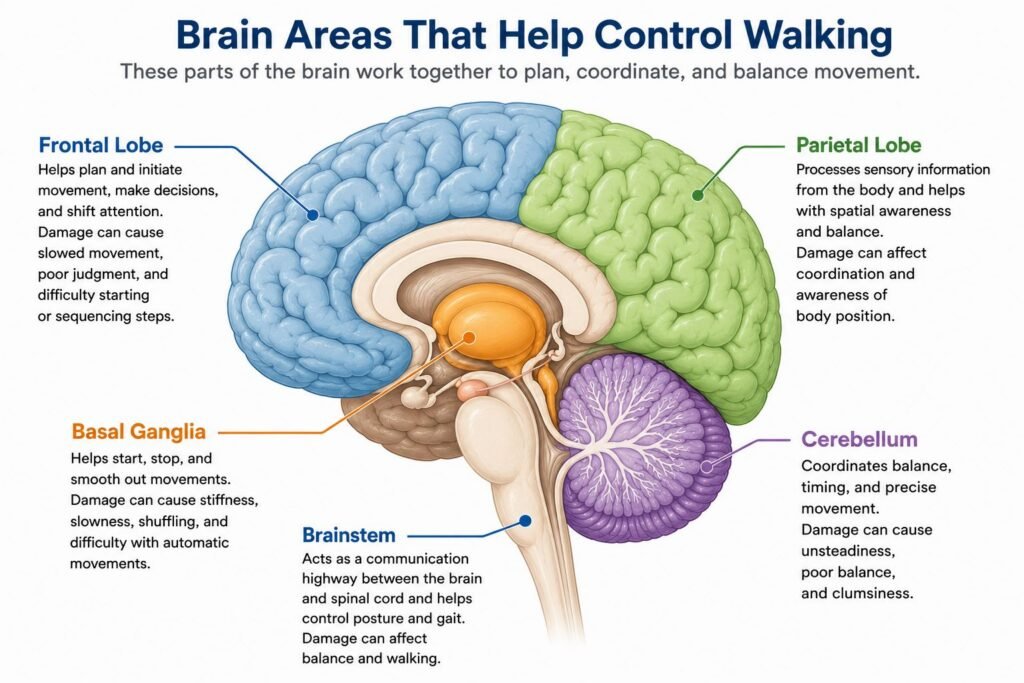
It’s important to remember that dementia does not usually damage just one part of the brain. Because these brain regions work together rather than independently, dementia rarely affects only one area. As the disease progresses, multiple brain regions become affected, making walking increasingly difficult. This is why mobility often declines gradually rather than all at once, and why each person’s experience can be different.
Early Walking Changes Families Often Notice
Walking problems caused by dementia usually develop gradually rather than overnight. In the early stages, the changes may be so subtle that family members attribute them to normal aging, arthritis, or simply being “more careful.” In many cases, families notice these changes months before they realize they are related to dementia.
However, these changes often reflect the brain having increasing difficulty coordinating movement, balance, and spatial awareness. Recognizing these early signs can help families seek medical advice, address safety concerns, and plan for future care needs.

Some of the earliest walking changes include:
- Walking more slowly than usual
- Taking shorter steps
- Shuffling the feet instead of lifting them normally
- Difficulty turning, especially in tight spaces
- Using furniture or walls for support while walking
- Fear of falling or becoming less confident when walking
- Frequent stumbling or tripping over small obstacles
- Hesitating before taking a step, as though unsure how to begin moving
Not everyone with dementia experiences these symptoms in the same way or at the same pace. The specific changes often depend on the type of dementia, the areas of the brain affected, and other health conditions the person may have.
Although these walking changes are common in dementia, they should not automatically be dismissed as a normal part of aging. New or worsening mobility problems should always be discussed with a healthcare professional, as they may also be caused by other treatable conditions, such as medication side effects, infections, vision problems, or stroke.
Why Walking Becomes Increasingly Difficult
As dementia progresses, the brain gradually loses its ability to coordinate the many tasks required for walking. Instead of one single problem causing mobility loss, several brain functions begin to decline at the same time.
These changes usually develop gradually, although the rate of progression varies from person to person.
The Brain Has Trouble Planning Movement
Before you take a single step, your brain must create a detailed “movement plan.” It decides which muscles need to move, when they should move, how much force to use, and how to maintain your balance throughout the process.
As dementia damages the frontal lobe and other areas involved in motor planning, creating this sequence becomes increasingly difficult. A person may hesitate before walking, appear unsure how to begin moving, or stop unexpectedly while walking because the brain can no longer organize the next step.
To family members, it may seem as though their loved one has forgotten how to walk. In reality, the disease is interfering with the brain’s ability to plan and coordinate movement.
Balance Becomes Less Reliable
Maintaining balance is another complex function controlled by the brain. Every second you’re standing or walking, your brain processes information from your eyes, inner ears, muscles, and joints to keep your body upright.
When dementia affects these brain networks, balance becomes less reliable. A person may sway while standing, become unsteady on uneven surfaces, or need to hold onto furniture, walls, or another person’s arm for support.
Because balance problems increase the risk of falls, creating a safe home environment becomes increasingly important as the disease progresses.
Spatial Awareness Declines
Walking safely requires your brain to understand where your body is in relation to the world around you. This ability, known as spatial awareness, helps you judge distances, avoid obstacles, and navigate safely through different environments.
As dementia progresses, this ability often declines. A person may:
- Misjudge the height of a step or curb
- Bump into furniture or door frames
- Become hesitant or frightened when approaching doorways
- Freeze or stop walking when moving from one type of flooring to another, such as from hardwood to carpet
These changes can be confusing for families because the obstacles may appear simple to everyone else, while the person with dementia experiences them very differently.
Judgment and Safety Awareness Change
Dementia can also affect judgment and the ability to recognize potential dangers.
A person may no longer realize that an uneven sidewalk, loose rug, staircase, or cluttered walkway presents a fall risk. Others may attempt to walk without assistance, even when they are no longer physically able to do so safely.
As judgment declines, caregivers often need to provide more supervision and make adjustments to the home environment to reduce the risk of injuries from falls.
The Muscles May Still Be Strong
One of the most common questions families ask is:
“If their legs still seem strong, why can’t they walk?”
The answer lies in the brain rather than the muscles.
In many people with dementia, the muscles remain capable of producing movement. However, the brain gradually loses its ability to send the precise, coordinated signals needed to control those muscles.
You can think of it like an orchestra. Even if every musician is talented and every instrument is in perfect condition, the music falls apart if the conductor can no longer coordinate the performance. In a similar way, dementia affects the brain’s ability to “conduct” the body’s movements. The muscles may still be capable of working, but without clear instructions from the brain, walking becomes increasingly difficult and may eventually no longer be possible.
Understanding this distinction can help families recognize that their loved one is not choosing to stop walking or refusing to try. Instead, the disease is progressively affecting the brain’s ability to coordinate movement, making mobility loss an expected part of advanced dementia for many individuals.
What Is Gait Freezing?
Some people with dementia experience a symptom known as gait freezing, or freezing of gait. During these episodes, the person suddenly becomes unable to take another step, even though they intend to keep walking.
Many people describe the sensation as though their feet are glued to the floor. The episode may last only a few seconds, but it can be frightening for both the person with dementia and their caregiver.
Freezing episodes often occur in situations that require the brain to process additional movement or environmental information, such as:
- Walking through a doorway
- Turning around
- Approaching stairs or curbs
- Stepping over an object
- Walking through crowded or unfamiliar areas
- Transitioning from one type of flooring to another
During a freezing episode, a person may appear stuck in place, shuffle their feet without moving forward, or repeatedly try to take a step without success. Because these episodes can happen without warning, they significantly increase the risk of falls.
Not everyone with dementia experiences gait freezing. It is more commonly seen in Lewy body dementia, Parkinson’s disease dementia, vascular dementia, and in some people with advanced Alzheimer’s disease. The likelihood and severity of freezing episodes vary depending on the type of dementia and the areas of the brain affected.
If gait freezing develops suddenly or becomes more frequent, it’s important to discuss it with the person’s healthcare provider. A medical evaluation can help determine whether medications, another neurological condition, or another treatable problem may also be contributing to the change.
Caregiver Tip: If your loved one freezes while walking, avoid pulling them forward. Instead, remain calm, encourage them to shift their weight, count aloud, or focus on taking one step at a time. In some cases, stepping over a visual cue, such as a line on the floor, may help restart movement. Ask a physical therapist for personalized techniques that are safe for your loved one’s condition.
Other Medical Conditions Can Also Affect Walking
Although dementia is a common cause of walking difficulties, not every mobility problem is caused by dementia itself. Many older adults have more than one medical condition, and several health issues can affect a person’s ability to walk safely.
For example, walking problems may also be caused or worsened by:
- Arthritis, which can make walking painful and limit joint movement.
- Stroke, which may cause weakness, poor coordination, or paralysis on one side of the body.
- Parkinson’s disease, a neurological disorder that commonly causes shuffling steps, stiffness, slow movement, and freezing of gait.
- Medication side effects, including dizziness, drowsiness, confusion, or changes in balance.
- Infections, such as urinary tract infections (UTIs) or pneumonia, which can cause sudden weakness, confusion, or difficulty walking in older adults.
- Dehydration, which may lead to dizziness, low blood pressure, weakness, and an increased risk of falls.
- Vision problems, making it more difficult to judge distances, recognize obstacles, or navigate safely.
- Pain, especially from conditions affecting the hips, knees, feet, or back, which can change the way a person walks.
Because many of these conditions can occur alongside dementia, it’s important not to assume that every new walking problem is simply part of the disease.
When Should You Seek Medical Evaluation?
If your loved one experiences a sudden or significant change in their ability to walk, contact their healthcare provider promptly. A medical evaluation can help determine whether a treatable condition is contributing to the change.
Seek medical attention if your loved one:
- Suddenly cannot walk or stand
- Develops new weakness, especially on one side of the body
- Falls repeatedly or has a significant fall
- Becomes much more confused than usual
- Complains of severe pain while walking
- Develops dizziness or repeatedly loses their balance
- Has signs of illness, such as a fever, dehydration, or a suspected infection
Prompt evaluation may identify a reversible problem that can improve mobility, reduce the risk of falls, and help your loved one maintain as much independence as possible.
Can Physical Therapy Help?
In many cases, yes. While physical therapy cannot stop or reverse dementia, it can often help people remain as mobile, safe, and independent as possible for longer.
A physical therapist evaluates how a person walks, maintains balance, transfers between surfaces, and performs everyday movements. Based on those findings, they develop a personalized plan designed to support the person’s current abilities and reduce the risk of falls. The American Physical Therapy Association (APTA) also emphasizes the important role physical therapy can play in improving mobility, reducing fall risk, and helping older adults maintain their independence whenever possible.
Depending on the stage of dementia and the individual’s overall health, physical therapy may help:
- Improve balance and stability while standing or walking
- Strengthen muscles needed for safe movement
- Maintain mobility and flexibility for as long as possible
- Reduce the risk of falls through balance training and home safety recommendations
- Teach caregivers safer ways to assist with walking and transfers, helping protect both the caregiver and the person with dementia from injury

In the earlier stages of dementia, therapy may help a person stay active and confident while walking. In the later stages, the focus often shifts toward maintaining comfort, preserving mobility for as long as possible, and teaching caregivers safe techniques for assisting with movement.
It’s important to remember that physical therapy works best when it begins before significant mobility loss occurs. Early intervention may help slow functional decline, improve confidence, and make everyday activities safer.
Although physical therapy cannot stop the progression of dementia, it can play an important role in helping people maintain their quality of life and independence for as long as possible.
When Should Families Talk to the Doctor?
Walking problems often develop gradually as dementia progresses. However, a sudden or significant change in mobility should never be ignored. New walking difficulties may be caused by another medical condition that requires prompt evaluation and treatment.
Contact your loved one’s healthcare provider as soon as possible if they:
- Suddenly cannot walk or stand when they were previously able to do so
- Begin falling frequently or experience repeated near falls
- Develop weakness on one side of the body, which could be a sign of a stroke
- Complain of severe pain in the hips, legs, back, or feet that affects walking
- Become unusually sleepy, difficult to wake, or much more confused than usual
- Show signs of a stroke, such as facial drooping, arm weakness, difficulty speaking, sudden vision changes, or loss of coordination
- Experience a sudden change in the way they walk, including new shuffling, freezing, dragging one leg, or a significant loss of balance
Some walking changes can be caused by infections, dehydration, medication side effects, fractures, or other treatable medical conditions rather than dementia itself. Prompt medical evaluation may identify a reversible problem and help prevent further complications.
If you suspect your loved one is having a stroke or another medical emergency, call 911 immediately. Early treatment can significantly improve outcomes.
When Walking Stops Completely
In the later stages of dementia, some people eventually lose the ability to walk altogether. This is one of the most difficult milestones families may face, and it often raises painful questions about whether something more could have been done.
For many people with advanced dementia, this loss of mobility occurs because the disease has progressively damaged the brain regions responsible for planning, coordinating, and controlling movement. Although muscles may also become weaker over time due to inactivity and overall health decline, the primary problem is often that the brain can no longer organize the complex signals needed for walking.
It’s important to understand that this does not necessarily mean your loved one has “given up” or stopped trying. Instead, it reflects the natural progression of a disease that gradually affects more areas of the brain. Just as dementia can eventually make it difficult to speak, swallow, or recognize family members, it can also impair the brain’s ability to control movement.
Many caregivers struggle with feelings of guilt, wondering whether more exercise, physical therapy, or different medical treatment could have prevented this decline. While staying active and addressing treatable medical conditions can help maintain mobility for as long as possible, dementia itself continues to progress. In many cases, losing the ability to walk is an expected part of advanced disease rather than something anyone could have prevented.
As mobility declines, the focus of care often shifts from preserving independence to promoting comfort, preventing falls, protecting skin health, and maintaining dignity. Families may also benefit from discussing future care options, including home health care, memory care, or hospice care, depending on their loved one’s needs and stage of illness. If hospice becomes appropriate, our article Hospice Care in a Nursing Home: Who Provides What and What Medicare Covers explains how hospice services work alongside nursing home care, what Medicare covers, and how the hospice team and nursing home staff work together to support both the resident and their family.
Although this stage is emotionally difficult, understanding why it happens can help families replace feelings of frustration or self-blame with compassion. Your loved one is not choosing to stop walking—the disease is gradually changing how their brain controls movement. Recognizing this reality can help caregivers make informed decisions and provide the support, patience, and reassurance their loved one needs throughout this stage of the journey.
Key Takeaways
- Walking is controlled by the brain as much as the muscles. Dementia affects the brain’s ability to plan, coordinate, and control movement.
- Walking problems usually develop gradually. Early signs may include slower walking, shorter steps, shuffling, poor balance, or hesitation before taking a step.
- Not every walking problem is caused by dementia. Sudden changes in mobility should always be evaluated by a healthcare professional to rule out treatable conditions, such as infections, medication side effects, or stroke.
- Physical therapy may help people with dementia stay mobile longer. While it cannot stop the progression of dementia, it can improve balance, reduce fall risk, and help caregivers learn safer ways to assist with walking and transfers.
- Losing the ability to walk is often part of advanced dementia. This happens because the disease gradually damages the brain’s ability to coordinate movement—not because the person has stopped trying or “given up.”
- Understanding why mobility changes occur can help families respond with compassion, plan for future care needs, and focus on keeping their loved one as safe and comfortable as possible.
Final Thoughts
Watching a loved one with dementia lose the ability to walk can be one of the most emotional and challenging parts of the disease. While this change is often heartbreaking, understanding that it results from progressive changes in the brain—not a lack of effort or determination—can help families approach this stage with greater compassion and realistic expectations.
Although there is no way to stop dementia from progressing, early medical evaluation, physical therapy, fall prevention, and appropriate support services can help many people remain safe and mobile for as long as possible. As the disease advances, the focus of care often shifts from preserving independence to promoting comfort, safety, dignity, and quality of life.
If you have questions about your loved one’s mobility or notice sudden changes in their ability to walk, don’t hesitate to speak with their healthcare provider. Prompt evaluation can identify treatable conditions and help ensure your loved one receives the most appropriate care.
Continue Learning About Dementia Care
If you’re caring for someone with dementia, these related resources can help you better understand the disease and prepare for the changes that may occur as it progresses:
- How Dementia Changes the Brain: Why Walking, Eating, and Communication Become Difficult
- Memory Care Explained: A Complete Guide for Families Navigating Alzheimer’s and Dementia Care
- Alzheimer’s Disease Explained: Symptoms, Stages, Causes, and Care Options for Families
- Parkinson’s Disease: The Essential Guide for Families and Caregivers
- What Is the Medicare GUIDE Model? A Complete Guide for Families Caring for Someone with Dementia
For additional information about dementia and its progression, visit the National Institute on Aging and the Alzheimer’s Association, which provide trusted, evidence-based resources for individuals living with dementia, caregivers, and families.
Frequently Asked Questions
Every person’s experience with dementia is unique, and families often have additional questions as walking and mobility change over time. The following answers address some of the most common concerns about why people with dementia stop walking, what to expect as the disease progresses, and how caregivers can provide safe, compassionate support.
Why do people with dementia stop walking?
People with dementia often stop walking because the disease gradually damages the parts of the brain responsible for planning movement, maintaining balance, coordinating muscles, and understanding where the body is in space. Although muscle weakness and other health conditions can contribute, the brain’s declining ability to control movement is usually the primary reason mobility is lost.
Is losing the ability to walk part of late-stage dementia?
Yes. Many people with advanced dementia eventually lose the ability to walk independently as the disease progresses. However, the timing varies from person to person and depends on the type of dementia, overall health, and whether other medical conditions are present.
Can someone with dementia learn to walk again?
It depends on the cause of the walking problem. If mobility declines because of a treatable condition, such as an infection, medication side effects, or an injury, walking may improve after treatment. However, if the loss of mobility is caused by advanced dementia, it is usually not reversible. Physical therapy may help maintain existing mobility and improve safety, but it cannot reverse the brain changes caused by dementia.
Does physical therapy help people with dementia walk longer?
In many cases, yes. Physical therapy can improve balance, strengthen muscles, reduce the risk of falls, and help people remain as mobile and independent as possible for longer. Although it cannot stop the progression of dementia, it can play an important role in maintaining function and teaching caregivers safe ways to assist with walking and transfers.
What causes shuffling in dementia?
Shuffling often occurs because dementia affects the brain’s ability to coordinate smooth, automatic movements. Instead of taking normal steps, a person may begin taking shorter, slower steps and have difficulty lifting their feet completely off the ground. Shuffling is more common in certain types of dementia, including Lewy body dementia, Parkinson’s disease dementia, and advanced Alzheimer’s disease.
When should I worry about sudden walking problems?
Contact your loved one’s healthcare provider if they suddenly cannot walk, begin falling frequently, develop weakness on one side of the body, complain of severe pain, become unusually sleepy or confused, or experience a sudden change in the way they walk. These symptoms may indicate a treatable medical condition or a medical emergency, such as a stroke.
Why does my loved one freeze while walking?
Some people with dementia experience freezing of gait, where they suddenly feel unable to take another step even though they want to continue walking. This often happens near doorways, during turns, or when navigating unfamiliar environments. Freezing is more common in Lewy body dementia, Parkinson’s disease dementia, vascular dementia, and some people with advanced Alzheimer’s disease.
Does Alzheimer’s disease always lead to loss of walking?
No. Not everyone with Alzheimer’s disease loses the ability to walk, and the progression varies widely from person to person. Many people remain mobile for years, while others gradually develop walking difficulties as the disease advances. Factors such as overall health, age, and other medical conditions also influence mobility.
What can caregivers do to help prevent falls?
Caregivers can reduce the risk of falls by removing tripping hazards, improving lighting, installing grab bars and handrails, encouraging appropriate footwear, using mobility aids when recommended, and discussing balance concerns with the healthcare provider or a physical therapist. Regular vision checks and medication reviews may also help reduce fall risk.
How can I safely help someone with dementia who can no longer walk?
Avoid trying to lift or transfer your loved one by yourself if it is unsafe to do so. Ask a healthcare professional or physical therapist to demonstrate safe transfer techniques and recommend any necessary equipment, such as gait belts, transfer boards, or mechanical lifts. As mobility declines, additional support through home health care, memory care, or hospice services may also help ensure your loved one remains safe, comfortable, and well cared for.
Is it normal for a person with dementia to sleep more after they stop walking?
As dementia progresses, many people spend more time sleeping and less time being physically active. Increased sleep often occurs because the disease affects more areas of the brain and the body requires more energy to perform even simple tasks. However, a sudden increase in sleepiness should always be evaluated by a healthcare provider, as it may be caused by an infection, medication side effect, dehydration, or another treatable medical condition.