
One of the most common questions families ask when exploring senior care is:
What is the difference between assisted living and a nursing home?
The question often comes up after a health change, hospital stay, fall, memory concerns, or increasing difficulty managing daily activities at home. Families want to find the right level of support, but understanding the differences between care options can be confusing.
While both assisted living communities and nursing homes provide housing, care, and support for older adults, they serve very different needs. Assisted living focuses on helping seniors maintain independence while receiving assistance with daily activities. Nursing homes provide a higher level of medical care and 24-hour nursing supervision for individuals with more complex health needs.
Understanding the differences between assisted living and nursing homes can help families make informed decisions, reduce uncertainty, and choose the care setting that best matches a loved one’s current and future needs.
Families who are new to senior care may also find our guide, Long-Term Care Explained: A Complete Guide for Families Navigating Senior Care, helpful for understanding the different types of long-term care services available.
In this guide, you’ll learn:
- What assisted living is
- What nursing homes provide
- The key differences between assisted living and nursing homes
- When each type of care may be appropriate
- Costs and payment options
- How to determine the right level of care
Quick Answer: Assisted Living vs Nursing Home
Assisted living communities support older adults who need help with daily activities such as bathing, dressing, medication reminders, and meals while maintaining as much independence as possible.
Nursing homes provide a higher level of care, including 24-hour nursing supervision, skilled nursing services, rehabilitation, and ongoing medical support for individuals with serious health conditions or recovery needs.
The key difference: Assisted living focuses on personal care and lifestyle support, while nursing homes provide medical care and continuous nursing supervision.
Understanding the Senior Care Continuum
Choosing between assisted living and a nursing home often becomes easier when families understand that senior care exists on a continuum of support.
As a person’s health, mobility, memory, or daily care needs change, the level of support they require may also change. Many older adults move gradually from more independent living environments to settings that provide greater assistance, supervision, and medical care.
Understanding where a loved one currently falls along the senior care continuum can help families identify the most appropriate level of care today while planning for future needs.
A simplified version of the senior care continuum may look like this:
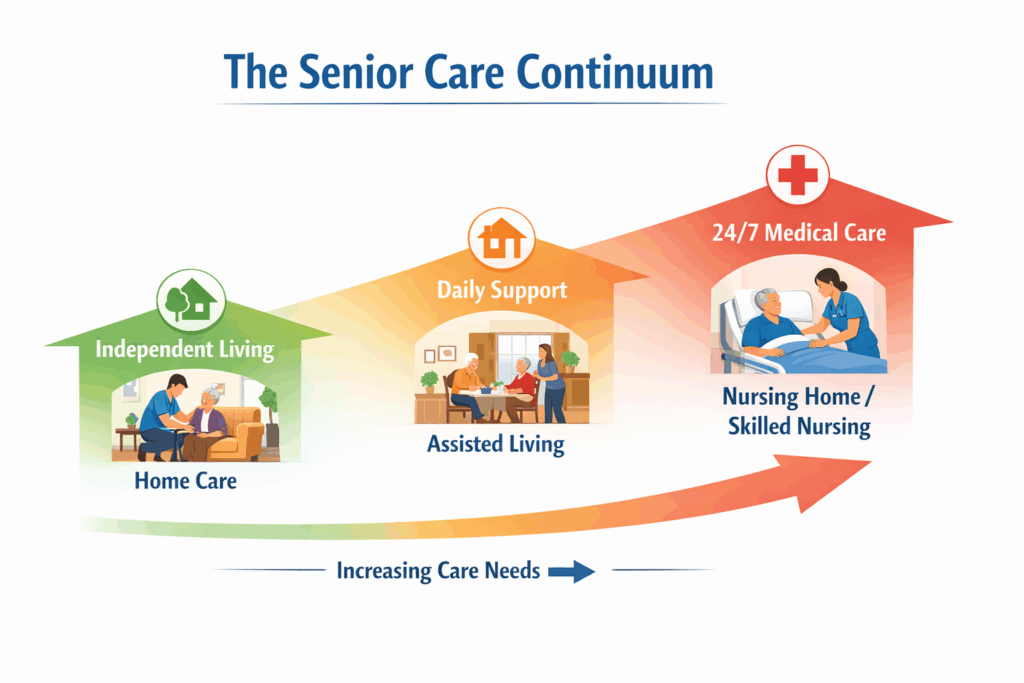
A simplified version of the care continuum may look like this:
| Level of Care | Typical Support |
| Independent Living | Minimal support and active lifestyle |
| Home Care | Assistance provided in the person’s home |
| Assisted Living | Help with daily activities and community support |
| Nursing Home / Skilled Nursing | Continuous medical supervision |
What Is Assisted Living?
Assisted living is a type of senior care designed for older adults who remain relatively independent but need help with certain daily activities. It provides a balance of housing, personal care, and supportive services while encouraging residents to maintain as much independence as possible.
Residents typically live in private or semi-private apartments and may receive assistance with:
- Bathing
- Dressing
- Medication reminders
- Meal preparation
- Transportation
- Housekeeping
According to the National Institute on Aging, assisted living communities provide housing, supportive services, and limited healthcare assistance for older adults who need help with everyday activities but do not require continuous medical supervision.
Assisted living communities often emphasize independence, social engagement, safety, and quality of life. Common features may include:
- Restaurant-style dining
- Social activities and events
- Fitness and wellness programs
- Transportation services
- Housekeeping and laundry
- 24-hour staff availability
Unlike nursing homes, assisted living communities focus primarily on assistance with daily living and supportive services rather than ongoing medical care. Many communities offer a residential, apartment-style environment designed to help older adults remain active, engaged, and connected while receiving the support they need.
Who Is Assisted Living Best For?
Assisted living may be a good option for older adults who need some assistance with daily activities but do not require continuous medical supervision.

It may be appropriate for seniors who:
- Need help with daily tasks such as bathing, dressing, or medication reminders
- Feel isolated or lonely living alone
- Want a safer living environment
- Can no longer manage household responsibilities independently
- Have experienced a recent fall or mobility challenges
- Would benefit from regular social interaction and activities
- Need support with meals, housekeeping, or transportation
- Want a maintenance-free lifestyle with supportive services
For example, an older adult who takes multiple medications, needs occasional assistance with personal care, or no longer feels comfortable managing daily responsibilities alone may benefit from the support and social opportunities offered by an assisted living community.
Families who are unsure whether it may be time for additional support can also read When Is It Time for Assisted Living? 12 Signs an Older Adult May Need More Support.
Because assisted living focuses on personal care rather than ongoing medical treatment, it is generally best suited for individuals who can still maintain a degree of independence while benefiting from additional support.
What Is a Nursing Home?
A nursing home, often called a skilled nursing facility, is a type of senior care designed for individuals who require ongoing medical care, rehabilitation services, or 24-hour nursing supervision.
According to the Centers for Medicare & Medicaid Services (CMS), skilled nursing facilities provide medical services such as rehabilitation therapy, medication management, and nursing care for individuals with complex health conditions or recovery needs.
Nursing homes are designed for older adults and individuals who need a higher level of support than can typically be provided in assisted living or at home.
Services often include:
- 24-hour licensed nursing care
- Medication administration
- Physical therapy
- Occupational therapy
- Speech therapy
- Wound care
- IV treatments
- Rehabilitation after surgery, illness, or injury
- Monitoring and management of chronic medical conditions

Unlike assisted living communities, nursing homes focus primarily on medical care and clinical support while also providing assistance with daily activities.
Doctors, nurses, therapists, and other healthcare professionals play a central role in daily care, helping residents receive the treatment, supervision, and support they need to maintain their health, safety, and quality of life.
Who Needs Nursing Home Care?
Nursing homes are typically appropriate for individuals who require a higher level of medical care and supervision than can be provided at home or in an assisted living community.
They often serve individuals who:
- Have serious or complex medical conditions
- Require daily medical monitoring or skilled nursing care
- Need rehabilitation after a hospitalization, surgery, illness, or injury
- Have advanced mobility limitations
- Require feeding tubes, IV treatments, wound care, or other specialized medical services
- Experience frequent hospitalizations or ongoing health complications
- Need extensive assistance with daily activities and personal care
For example, someone recovering from a stroke, major surgery, or severe illness may temporarily stay in a nursing home for short-term rehabilitation before returning home. Others may live in a nursing home long-term due to chronic medical conditions, advanced frailty, or the need for ongoing nursing supervision.
Assisted Living vs Nursing Home: Key Differences
While both assisted living communities and nursing homes provide housing, care, and support for older adults, the level of care, medical services, and overall living environment can differ significantly.
Comparing the two side by side can help families better understand which option may be most appropriate for a loved one’s needs.
| Category | Assisted Living | Nursing Home |
| Purpose | Support with daily living | Medical care and monitoring |
| Best For | Seniors who need some assistance but remain relatively independent | Seniors with serious health conditions or extensive care needs |
| Staff | Care aides and support staff | Licensed nurses, therapists, and healthcare professionals |
| Medical Care | Limited | Extensive |
| Housing | Private or semi-private apartments | Private or shared resident rooms |
| Activities | Social, recreational, and lifestyle focused | Rehabilitation and medically supervised activities |
| Average Cost | Generally lower | Generally higher |
The most important distinction is the level of care provided. Assisted living focuses on personal care, daily living assistance, and maintaining independence, while nursing homes provide ongoing medical care, skilled nursing services, and continuous supervision for individuals with more complex health needs.
Common Misconceptions About Assisted Living and Nursing Homes
Families often hear conflicting information when researching senior care. Unfortunately, some of the most common beliefs about assisted living and nursing homes are based on misunderstandings rather than facts. Clearing up these misconceptions can help families make more informed and confident care decisions.
Assisted Living and Nursing Homes Are the Same
Although both provide housing and care for older adults, they serve very different needs. Assisted living focuses on personal care, daily living assistance, and maintaining independence, while nursing homes provide skilled nursing services, medical supervision, and rehabilitation for individuals with more complex health needs.
Nursing Homes Are Only for End-of-Life Care
Many people assume nursing homes are only for individuals at the end of life, but that is not the case. Some residents stay temporarily for rehabilitation after surgery, illness, injury, or hospitalization before returning home. Others require long-term nursing care due to ongoing medical conditions.
Moving to Assisted Living Means Losing Independence
In many cases, assisted living can actually help older adults maintain independence longer. By providing assistance with tasks that have become challenging, residents often gain more time and energy to focus on social activities, hobbies, wellness programs, and other aspects of daily life.
Families Have Failed If a Loved One Needs More Care
Needing additional support is often a result of changing health needs, not a failure by the individual or family. As people age, medical conditions, mobility limitations, and safety concerns can make a higher level of care necessary. Choosing a care environment that provides appropriate support is often one of the most caring and responsible decisions a family can make.
Cost Differences Between Assisted Living and Nursing Homes
The cost of senior care varies based on location, accommodations, services provided, and the level of care required. According to Genworth’s Cost of Care Survey, average monthly costs in the United States are approximately:
| Care Type | Average Monthly Cost |
| Assisted Living | $4,500 – $5,500 |
| Nursing Home (semi-private room) | $8,000 – $9,000 |
| Nursing Home (private room) | $9,000 – $10,500 |
In general, nursing homes cost significantly more than assisted living communities because they provide 24-hour nursing supervision, skilled medical care, rehabilitation services, and a higher staff-to-resident ratio.
Costs can vary considerably by state, city, and provider. Urban areas and regions with a higher cost of living often have higher senior care costs than rural communities.
Families should also ask what services are included in the monthly fee, as pricing structures and additional charges can vary between providers.
Does Medicare Pay for Assisted Living or Nursing Homes?
One of the most common questions families ask is whether Medicare will help pay for senior care.
In most cases, Medicare does not cover long-term assisted living costs or long-term custodial nursing home care. However, Medicare may cover certain healthcare services and short-term skilled nursing care when specific eligibility requirements are met.
For example, if a person has a qualifying hospital stay and requires rehabilitation afterward, Medicare may help cover a temporary stay in a skilled nursing facility for a limited period of time. More detailed information is available on the official Medicare website: https://www.medicare.gov
For ongoing long-term care needs, families often rely on a combination of:
- Personal savings and retirement income
- Long-term care insurance
- Veterans benefits
- Medicaid
Because Medicare, Medicaid, and long-term care coverage rules can be complex, families should review their specific situation and consult official resources when planning for care expenses.
Warning Signs a Higher Level of Care May Be Needed
In some cases, an older adult may begin in assisted living but later develop care needs that require a higher level of medical support. Recognizing these changes early can help families make informed decisions and avoid unnecessary health or safety risks.
Signs that a nursing home or skilled nursing facility may be necessary include:
- Frequent hospitalizations or emergency room visits
- Complex medication management needs
- Severe mobility limitations or increased fall risk
- Advanced dementia or significant cognitive decline
- The need for daily skilled nursing care
- Feeding tubes, IV treatments, or specialized medical procedures
- Worsening chronic health conditions that require close monitoring
- Difficulty performing most Activities of Daily Living (ADLs)
If these needs arise, transitioning to a nursing home or skilled nursing facility may provide a safer environment and access to the medical care and supervision required to support the individual’s health and well-being.
A Simple Care Level Decision Framework for Families
One of the most challenging parts of choosing senior care is determining how much support a loved one actually needs.
Rather than focusing immediately on whether assisted living or a nursing home is the right choice, families can start by evaluating daily care needs, medical conditions, safety concerns, and overall well-being.
Step 1: Evaluate Daily Living Needs
Healthcare professionals often use Activities of Daily Living (ADLs) to assess how much support a person may need. ADLs include essential tasks such as bathing, dressing, eating, mobility, toileting, and personal hygiene.
Difficulty performing multiple ADLs may indicate that additional support or a higher level of care is needed.
Activities of Daily Living General Guideline for Levels of Care
| Number of ADL Challenges | What It May Indicate | Possible Care Option |
| 0–2 ADL challenges | Mostly independent with occasional assistance needed | Independent living or home care |
| 3–4 ADL challenges | Regular assistance needed with daily activities | Assisted living |
| 5–6 ADL challenges | Significant support and supervision required | Nursing home or skilled nursing facility |
Step 2: Assess Medical Complexity
Medical needs are another important factor when determining the appropriate level of care.
Consider questions such as:
- Does the person require daily nursing care?
- Are medications becoming difficult to manage?
- Have hospitalizations become more frequent?
- Are chronic health conditions becoming harder to monitor?
When medical needs become more complex, skilled nursing care may be necessary.
Step 3: Consider Safety Risks
Safety concerns often play a major role in care decisions.
Warning signs may include:
- Frequent falls
- Wandering related to memory loss
- Difficulty managing medications
- Leaving stoves or appliances on
- Poor hygiene or unexpected weight loss
Step 4: Evaluate Social and Emotional Well-Being
Care decisions involve more than physical health alone.
Social isolation can affect emotional well-being, cognitive health, and overall quality of life. Many assisted living communities provide opportunities for social engagement through activities, shared meals, fitness programs, and community events.
Step 5: Determine the Right Care Level
After evaluating daily living needs, medical conditions, safety concerns, and social well-being, families can often identify the most appropriate level of care.
| Situation | Care Option Often Considered |
| Mostly independent but needs occasional help | Home care services |
| Needs help with daily tasks but minimal medical needs | Assisted living |
| Advanced medical needs or rehabilitation | Nursing home or skilled nursing facility |
Care needs often change over time. Choosing the right level of care today does not prevent future transitions if additional support becomes necessary.
Taking the Next Step: Comparing Care Options
Once families have a better understanding of their loved one’s care needs, the next step is often exploring local assisted living communities and nursing homes.
Visiting communities in person can provide valuable insight into the environment, staff, services, and overall quality of care. When touring a community, pay attention to:
- Staff interactions with residents
- Cleanliness and safety
- Activity schedules and resident engagement
- Dining options and meal quality
- Staff availability and responsiveness
- Communication with families
Families should also ask about costs, available services, admission requirements, and how the community handles changing care needs over time.
Many families begin their search online to compare care options, review amenities, and learn more about providers in their area. Exploring multiple communities and asking questions can help families make a more informed and confident decision.
At longtermcarefinder.com, families can search for assisted living communities, nursing homes, memory care providers, home health agencies, hospice services, and other senior care options based on location and care needs.
Final Thoughts
Understanding the difference between assisted living and nursing homes can help families make more informed senior care decisions.
While both provide valuable support for older adults, they serve different needs. Assisted living is designed for individuals who need help with daily activities while maintaining as much independence as possible. Nursing homes provide a higher level of medical care and 24-hour nursing supervision for those with more complex health needs.
When comparing assisted living vs nursing home care, the most important factor is understanding the level of support a loved one needs today while also considering future care needs. Taking time to evaluate daily living challenges, medical conditions, safety concerns, and personal preferences can help families choose the most appropriate care setting.
Every situation is unique, but with the right information, thoughtful planning, and open conversations, families can find a care solution that supports safety, dignity, comfort, and quality of life for the people they love.
Frequently Asked Questions About Assisted Living vs Nursing Homes
Families often have questions when comparing assisted living and nursing homes. The answers below address some of the most common concerns about care needs, costs, Medicare and Medicaid coverage, dementia care, and how to determine which option may be the best fit for a loved one.
Is assisted living the same as a nursing home?
No. Although both provide housing and support for older adults, assisted living focuses on personal care and daily living assistance, while nursing homes provide ongoing medical care and continuous nursing supervision.
What is the main difference between assisted living and a nursing home?
The main difference is the level of care provided. Assisted living communities help older adults with daily activities such as bathing, dressing, meals, and medication reminders while encouraging independence. Nursing homes provide 24-hour skilled nursing care, medical supervision, rehabilitation services, and support for individuals with more complex health needs.
Is assisted living cheaper than a nursing home?
In most cases, yes. Assisted living is generally less expensive because it focuses on personal care and lifestyle support. Nursing homes typically cost more due to licensed nursing staff, medical services, and around-the-clock supervision.
Does Medicare pay for assisted living?
Medicare generally does not pay for long-term assisted living costs. However, Medicare may cover certain healthcare services received while living in an assisted living community, such as physician visits, therapy, or home health services if eligibility requirements are met.
Does Medicare pay for nursing home care?
Medicare may cover a short-term stay in a skilled nursing facility after a qualifying hospital stay when rehabilitation or skilled nursing services are medically necessary. Medicare does not typically cover long-term custodial nursing home care.
Does Medicaid pay for assisted living or nursing homes?
Medicaid may help cover nursing home care for eligible individuals and, in some states, may also help pay for certain assisted living services through Medicaid waiver programs. Coverage varies by state and eligibility requirements.
Can someone move from assisted living to a nursing home later?
Yes. Many older adults begin in assisted living and later transition to a nursing home if their medical needs increase or they require a higher level of care. Care needs often change over time, making future transitions common.
Can a person with dementia live in assisted living?
Some individuals with early-stage dementia can live in assisted living communities, especially those that offer memory care programs. As dementia progresses, a higher level of supervision or specialized memory care support may become necessary.
What services are included in assisted living?
Services often include assistance with bathing, dressing, medication reminders, meals, housekeeping, laundry, transportation, social activities, and 24-hour staff availability. Services vary by community.
What services are provided in a nursing home?
Nursing homes typically provide 24-hour nursing care, medication administration, rehabilitation therapy, wound care, chronic disease management, assistance with daily activities, and medical monitoring.
What Happens When Assisted Living Can No Longer Meet a Resident’s Needs?
If a resident’s care needs become too complex for assisted living, the community will work with the family and healthcare providers to determine the most appropriate next step. Depending on the situation, this may include additional services, memory care, hospice support, or a transition to a nursing home or skilled nursing facility. Families should ask about aging-in-place options when evaluating communities.
What are the signs that a senior may need a nursing home instead of assisted living?
Signs may include frequent hospitalizations, advanced mobility limitations, complex medical conditions, the need for skilled nursing care, difficulty managing medications, feeding tubes, IV treatments, or significant safety concerns.
Who decides when it is time for a nursing home?
The decision is often made with input from physicians, healthcare professionals, hospital discharge planners, family members, and the older adult whenever possible. The individual’s medical needs, safety, and ability to perform daily activities are important factors.
How can families choose the right senior care option?
Yes. Hospice care can often be provided wherever a person lives, including assisted living communities, nursing homes, residential care homes, or a private residence. Hospice works alongside the existing care team to provide comfort-focused care, pain and symptom management, emotional support, and assistance for both the individual and their family.
Continue Your Senior Care Journey
Not sure what type of care is right for your loved one? These resources can help:
- Senior Care Planning: How to Plan for Long-Term Care Before a Crisis Happens
- Memory Care Explained: A Complete Guide for Families Navigating Alzheimer’s and Dementia Care
- Hospice Care Explained: A Complete Guide for Families Facing End-of-Life Care
- 10 Things Families Often Miss During an Assisted Living Tour
- Family Caregiver Burnout: Warning Signs, Causes, and Support Every Caregiver Needs
Ready to Explore Care Options Near You?
Compare assisted living communities, nursing homes, memory care providers, home health agencies, hospice providers, and other senior care services based on your loved one’s needs, location, and preferences.