
Running a residential care home is more than managing a business — it is caring for people in a deeply personal way, often every single day.
For many residential care home owners, the role goes far beyond administration and oversight. You are involved in the daily rhythms of the home, supporting residents through vulnerable moments, reassuring families, and making decisions that carry real emotional weight.
That level of responsibility can be incredibly meaningful. It can also be exhausting.
When your work is centered on caring for others, it is easy to place your own well-being last — until the emotional strain begins to show. Burnout does not always arrive suddenly. More often, it builds quietly, over time, especially in small homes where the owner is closely connected to every part of the care.
This article explores the emotional toll of running a residential care home and offers thoughtful ways to protect your energy, your compassion, and yourself — so you can continue doing the work you care about without losing yourself in the process.
The Unique Weight Owner-Caregivers Carry
Small residential care home owners often live in two worlds at once.
On one side, there are business responsibilities: licensing, staffing, compliance, finances, inspections, marketing, and family communication.
On the other, there is the human side of care: forming real relationships with residents, supporting families through difficult transitions, and witnessing decline, loss, and grief up close.
Because the home is small, the emotional boundaries are often thinner. Residents are not “clients” — they become familiar faces, routines, and stories. Their families know you by name and trust you deeply.
That closeness is a strength. But it also means the emotional load does not end when your shift does.

Signs the Emotional Toll Is Catching Up With You
Many owner-caregivers normalize exhaustion because caring has always required sacrifice. But there are quiet warning signs worth paying attention to:
- Feeling constantly drained, even after rest
- Becoming irritable or emotionally numb
- Dreading tasks you once found meaningful
- Carrying guilt when you take time off
- Feeling alone in decision-making
- Having trouble separating work from personal life
These are not signs of weakness. They are signs that you care deeply — and that you are human.
Why Burnout Is Especially Risky in Small Homes
In larger facilities, responsibilities are often spread across departments. In small residential homes, much of the emotional and operational responsibility rests on one person.
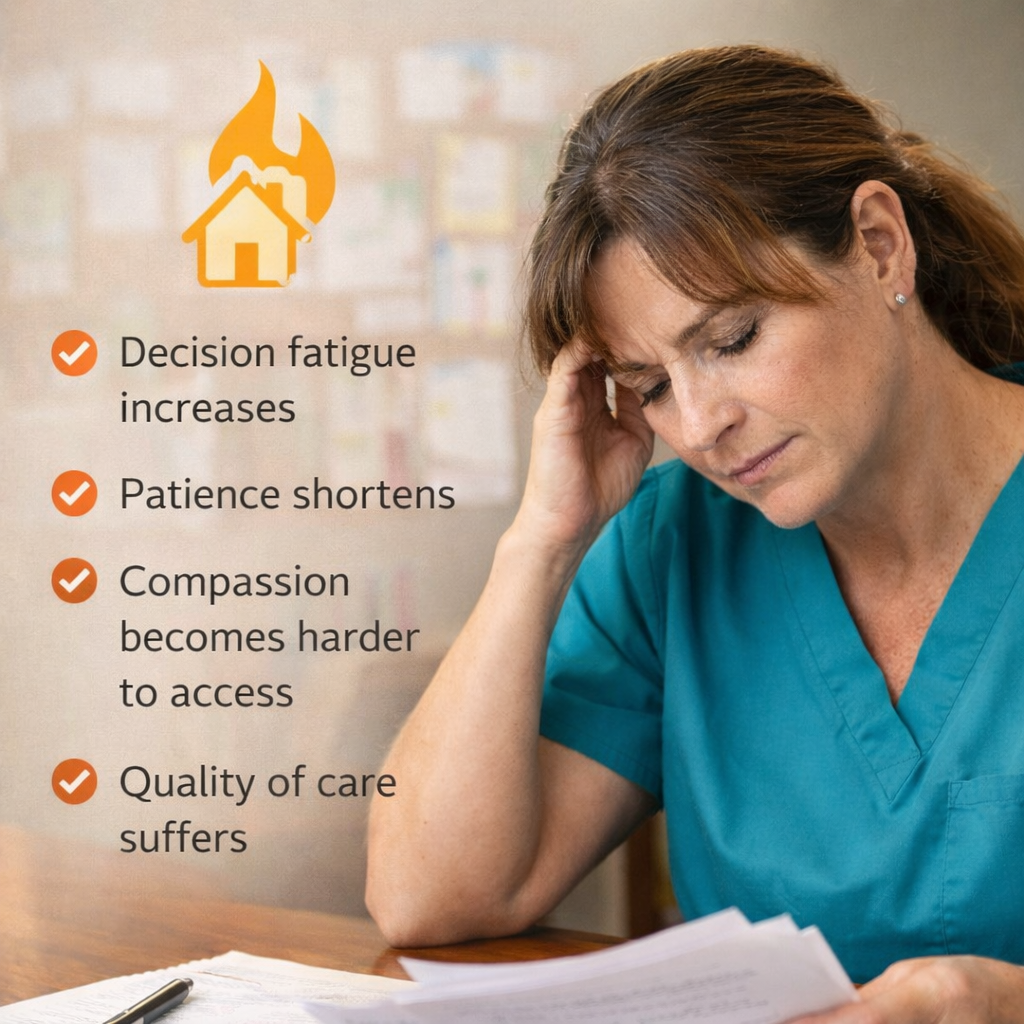
When an owner burns out:
- Decision fatigue increases
- Patience shortens
- Compassion becomes harder to access
- The quality of care can quietly suffer — even with the best intentions
Caring for yourself is not separate from caring for your residents. It is part of it.
Healthy Ways to Manage the Emotional Load
Managing the emotional toll does not mean caring less. It means caring more sustainably.
1. Acknowledge that your role is emotionally demanding
Naming the difficulty does not make you less professional. It makes you honest.
2. Build emotional boundaries, not emotional walls
You can be compassionate without carrying every outcome on your shoulders. Remind yourself what is within your control — and what is not.
3. Create moments where you are not “the owner”
Whether it is a scheduled day off, protected personal time, or delegating specific responsibilities, you need spaces where you are not on call mentally or emotionally.
4. Talk to someone who understands the industry
This could be another care home owner, a trusted mentor, or a professional who understands caregiving environments. Isolation makes everything heavier.
5. Reconnect with why you started
Burnout often disconnects us from purpose. Revisiting your original “why” — even briefly — can help ground you during difficult seasons.
You Are Not Meant to Do This Alone
Many small residential care home owners carry the emotional weight quietly, believing it is simply part of the job. But support, visibility, and connection matter — especially in a role that blends business ownership with deep personal care.
Taking care of yourself is not a luxury. It is a responsibility — to your residents, your staff, and yourself.
When you are supported, seen, and given room to breathe, your care remains what it has always been: compassionate, steady, and deeply human.